Vibration Monitoring for Brisbane Construction Projects
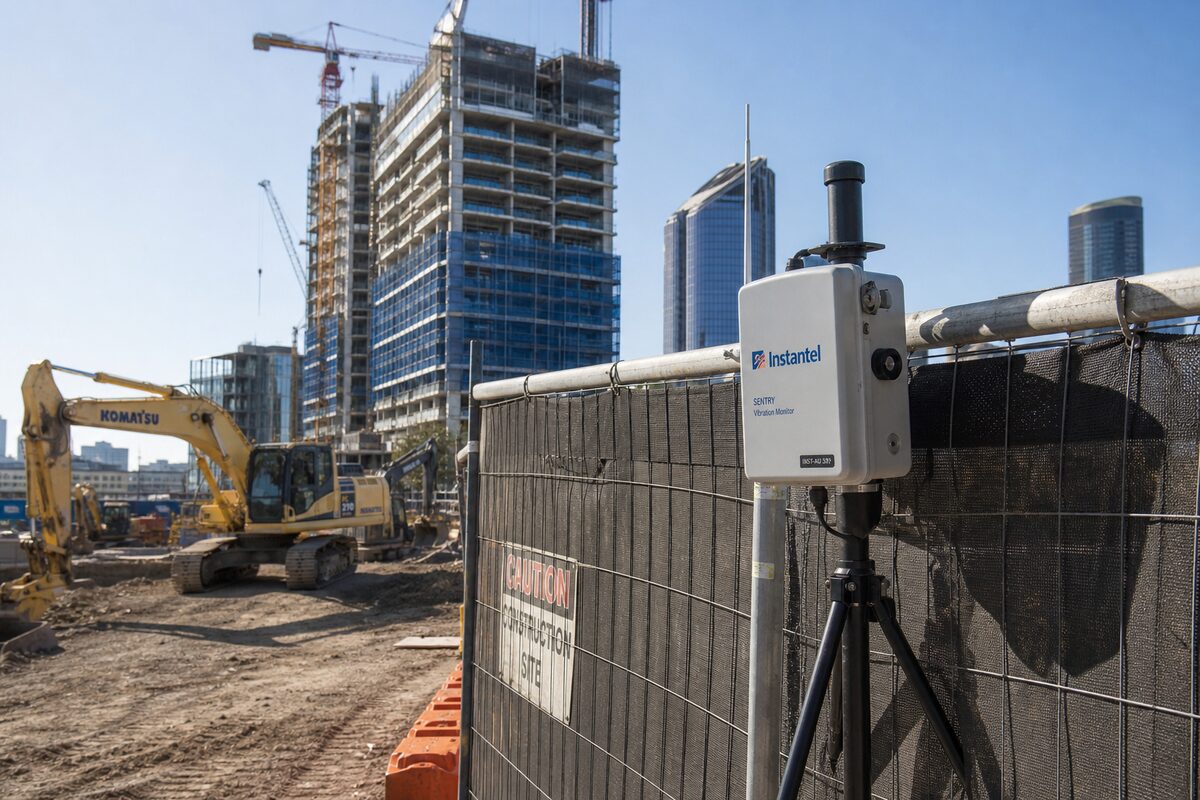
Brisbane's inner-city construction environment presents some of the most demanding vibration monitoring conditions in Queensland. Dense residential and commercial precincts, proximity to active rail corridors, and the concentration of heritage-listed structures across the CBD and inner suburbs mean that nearly every major project triggers formal vibration monitoring obligations. Those obligations flow from multiple approval pathways simultaneously: development approvals issued by Brisbane City Council, concurrence agency conditions from the State Assessment and Referral Agency, and environmental authority conditions administered by the Department of Environment and Science.
Understanding which body has issued which condition, and what standard each condition references, is the starting point for any monitoring programme on a Brisbane project. Getting this wrong early creates compliance gaps that are difficult to close mid-construction, particularly when excavation and piling works are already underway and complaints are arriving from neighbouring occupants or infrastructure owners.
The following covers the regulatory structure relevant to Brisbane projects, the project types most commonly triggering mandatory monitoring, sensor deployment approaches suited to Brisbane's built environment, threshold requirements under applicable standards, and reporting obligations that principal contractors and developers need to build into their programme from day one.
Regulatory Structure: BCC, SARA, and Queensland Rail
Brisbane City Council processes development applications under the Planning Act 2016 and, for projects in proximity to sensitive receivers, routinely imposes vibration monitoring conditions directly in the development approval. These conditions typically reference AS 2187.2-2006 for blasting or, for non-explosive construction vibration, point to DIN 4150-3:2016 or BS 7385-2:1993 as the applicable threshold documents. BCC conditions frequently specify pre-construction dilapidation surveys, real-time monitoring during high-vibration activities, and notification protocols to affected parties.
SARA operates as a concurrence agency for development applications that trigger state interest triggers, including transport infrastructure, state-controlled roads, and certain environmental values. For projects within the referral corridors of the Brisbane CBD and inner suburbs, SARA conditions are layered on top of BCC conditions, and they are not always aligned on threshold values or reporting frequency. A builder may find that BCC requires weekly reporting during piling and SARA requires incident-based reporting to the Department of Transport and Main Roads within 24 hours of a threshold exceedance.
Queensland Rail holds separate third-party asset protection requirements that apply to any works within 25 metres of rail infrastructure, a separation distance that captures a large portion of inner-city Brisbane's active construction sites given the density of the suburban and City network. QR's requirements reference their own internal guidelines, which generally adopt DIN 4150-3 threshold values for track and structures but add specific requirements around possession windows, vibration isolation, and real-time telemetry with direct feed access for QR engineers. Projects near the Cross River Rail tunnels must also contend with Rail, Road and Community (RRCA) deed conditions that were negotiated during the project's environmental impact assessment process.
Project Types That Trigger Monitoring Obligations
Cross River Rail Adjacent Works
The Cross River Rail project has fundamentally changed the compliance environment for Brisbane CBD and inner-suburban construction. Projects within the project's declared construction management area, or within close proximity to the tunnel alignment running from Dutton Park through to Bowen Hills, face layered obligations. Contractors building basement car parks, installing dewatering systems, or conducting driven piling in these areas must demonstrate that their works will not induce settlement or vibration into the tunnel segments and station boxes.
Monitoring here goes beyond standard construction vibration thresholds. The tunnel linings are young concrete structures with defined deflection tolerances, and the alliance contractors who delivered the tunnels specified monitoring trigger and action levels in their project completion documentation. Any builder now working near that alignment should be engaging a structural monitoring specialist to review those handover documents before mobilising.
Queens Wharf and CBD Precinct Developments
The Queens Wharf precinct and the broader William Street and George Street corridors are areas where heritage-listed buildings, occupied commercial towers, and major civil infrastructure are within practical construction influence zones of each other. Excavation for basement levels in this precinct requires monitoring of adjacent structures for both vibration and differential settlement. Ground movement monitoring using tiltmeters and crack gauges on heritage structures is now a standard BCC condition for basement excavation in these blocks.
The George Street Courthouse precinct, Queensland Parliament, and Treasury Building are all structures where BCC and the Queensland Heritage Council have required pre-construction structural condition surveys followed by continuous monitoring during nearby excavation. Tiltmeter data logged at one-minute intervals with real-time alerting has been the required approach on multiple projects in this corridor.
Inner-City Apartment Construction Near Rail
The construction boom in inner suburbs such as South Brisbane, Fortitude Valley, Newstead, Bowen Hills, and Woolloongabba has placed hundreds of residential construction sites within the influence zones of the suburban rail network. For these projects, the typical monitoring obligation involves a triaxial geophone or MEMS accelerometer array on the rail corridor boundary, real-time data logging, and an agreed-upon threshold matrix with Queensland Rail.
Occupied apartment buildings adjacent to construction sites in these suburbs also generate direct BCC conditions requiring construction noise and vibration monitoring under AS/NZS 2107:2016 for acceptable internal noise levels in residential settings, cross-referenced against DIN 4150-3 thresholds for structural protection of the adjacent buildings.
Applicable Thresholds: What the Standards Require
DIN 4150-3 for Structural Protection
DIN 4150-3:2016 is the most commonly referenced standard for construction vibration in Brisbane approval conditions. It defines threshold values in terms of peak particle velocity (PPV) measured in mm/s at the foundation of a receiving structure. The relevant values depend on the structural category of the receiving building:
- Line 1 (industrial structures):: 20 mm/s PPV at frequencies above 10 Hz
- Line 2 (residential and similar structures):: 5 mm/s PPV at 1-10 Hz, 5-20 mm/s PPV at 10-50 Hz, and 20-40 mm/s PPV above 50 Hz
- Line 3 (particularly sensitive structures):: 3 mm/s PPV at 1-10 Hz, 3-8 mm/s PPV at 10-50 Hz, and 8-10 mm/s PPV above 50 Hz
Heritage buildings in Brisbane are generally classified under Line 3 or equivalent, and QR rail infrastructure is treated with specific internal threshold values that are more conservative than DIN Line 2. These threshold values apply at the measurement point at the structure foundation, not at the source or mid-field, so sensor placement is directly specified by the standard's application.
BS 7385-2 for Cosmetic Damage
BS 7385-2:1993 provides guidance on vibration levels that may cause cosmetic damage to buildings, expressed as PPV at the base of the structure. It is referenced in some Brisbane BCC conditions, particularly for older residential buildings in inner suburbs like Paddington, Red Hill, and New Farm, where rendered masonry is the dominant building type and is susceptible to cosmetic cracking at lower PPV values than modern construction.
Under BS 7385-2, the threshold for onset of cosmetic cracking in residential buildings is in the range of 15 mm/s at frequencies above 10 Hz, but conditions applied to sensitive structures and heritage fabric often use 3-5 mm/s as the action level, consistent with DIN 4150-3 Line 3.
AS 2187.2 for Blasting
Where demolition or hard rock excavation involves explosives, AS 2187.2-2006 applies directly. This standard specifies PPV limits of 5 mm/s for residential structures, with frequency weighting provisions. Brisbane inner-city projects rarely involve open blasting, but controlled demolition in the CBD and tunnel boring machine (TBM) breakthrough events during Cross River Rail-adjacent works required AS 2187.2 monitoring at nominated receiver buildings.
Sensor Deployment for Brisbane Conditions
Triaxial Geophones and MEMS Accelerometers
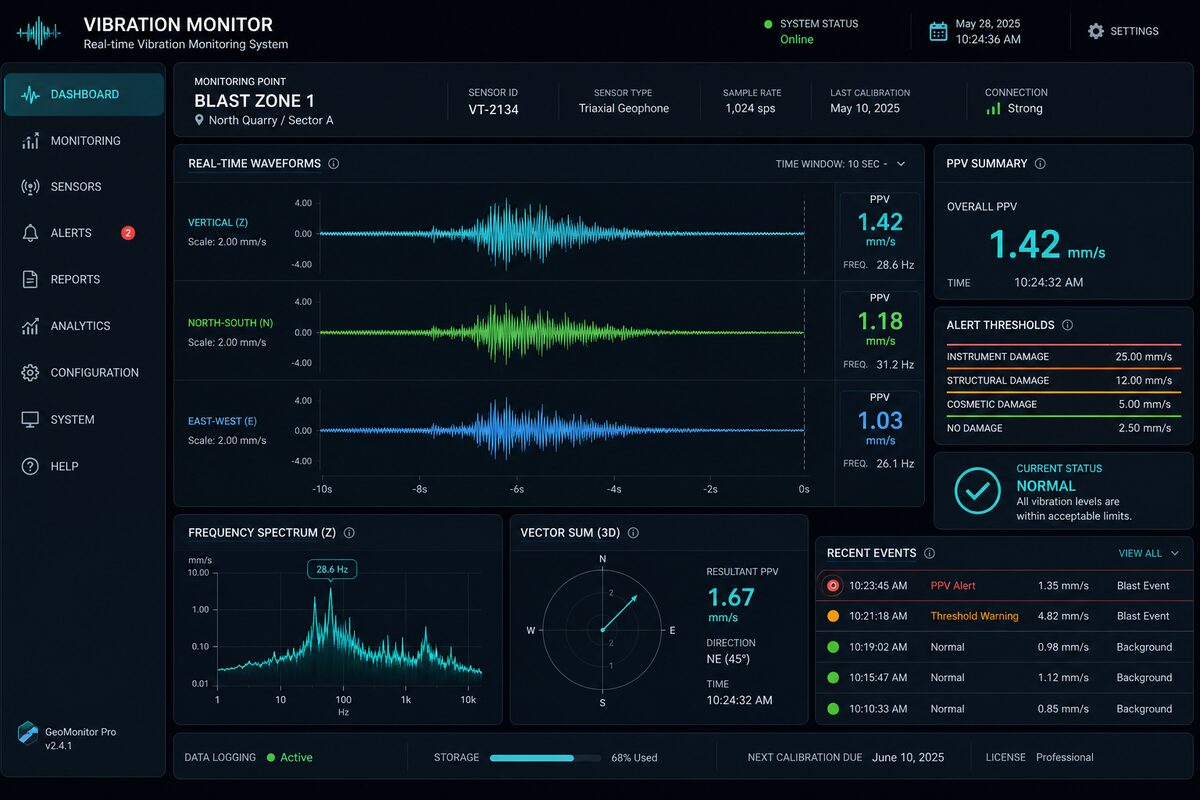
The standard sensor for construction vibration monitoring on Brisbane sites is a triaxial geophone measuring velocity in the vertical, longitudinal, and transverse axes simultaneously. PPV is calculated from the vector sum or from the single highest-axis reading, depending on which method the approval condition specifies. For structural protection monitoring, sensors are surface-mounted or grouted into the foundation wall of the receiving structure to capture ground-borne vibration accurately.
MEMS accelerometers have become more common in Brisbane deployments over the past five years, particularly for continuous monitoring programmes on heritage buildings where low-frequency ground movement from dewatering or surcharge loading needs to be captured alongside higher-frequency construction vibration. MEMS sensors offer wider dynamic range and lower noise floors at low frequencies than traditional geophones, which matters when the trigger levels are in the 1-3 mm/s range.
Tiltmeters and Crack Gauges for Structural Response
Heritage buildings and structures adjacent to deep basement excavations require monitoring beyond PPV. Tiltmeters measuring to 0.001-degree resolution log angular displacement of walls and columns over the construction period. Crack gauges mounted across pre-existing cracks in masonry or concrete establish baseline crack widths and detect any construction-induced change. On Brisbane CBD projects, these sensors typically operate continuously with one-minute logging intervals and 15-minute alert intervals sent to the project's engineering team.
Sensor networks on complex Brisbane sites often combine four to eight triaxial geophones, four to twelve tiltmeters, and six to twenty crack gauges, all integrated into a single IoT data platform with real-time dashboard access for the principal contractor, the structural engineer of record, BCC's compliance officer, and QR's asset protection team simultaneously.
IoT Telemetry and Real-Time Alerting
Real-time alerting is now a standard requirement rather than an option on Brisbane major projects. Approval conditions from SARA and BCC increasingly specify that the monitoring system must be capable of generating an automated alert to nominated persons within a defined period after a threshold exceedance, typically 15 to 30 minutes. This requirement means that manual data review is not sufficient; the monitoring system must have automated trigger detection and notification built in.
IoT-connected monitoring units transmitting via 4G with redundant cloud storage are the current standard deployment. Data retention requirements under Queensland project approval conditions typically specify a minimum of seven years, which has implications for the data management platform selected at the start of the project.
Reporting and Compliance Obligations
Pre-Construction Baseline and Dilapidation
Before any high-vibration works commence, approval conditions on Brisbane projects typically require a pre-construction dilapidation survey of all structures within a defined influence zone, usually 50 metres for driven piling and up to 200 metres for blasting or TBM operations. The dilapidation survey establishes the pre-existing condition of structures, which is the baseline against which any post-construction claims are assessed.
Concurrent with the dilapidation survey, a baseline vibration measurement campaign at each receiver location provides the ambient vibration environment before construction influence begins. This baseline data is essential for demonstrating that any measured vibration exceedances during construction are causally linked to the construction works rather than pre-existing sources such as road traffic or rail operations.
During-Construction Reporting
BCC conditions on Brisbane projects typically require a monthly vibration monitoring report submitted to Council's development compliance team during high-vibration work phases. SARA conditions may require weekly reporting or event-based reporting within 24 to 48 hours of a threshold exceedance, depending on how the concurrence agency conditions were drafted. Queensland Rail requires immediate notification of any exceedance of their agreed thresholds, followed by a written incident report within 24 hours.
During-construction reports should document:
- Measurement locations and sensor configuration: against the approved monitoring plan
- PPV data: for each high-vibration event, presented as time histories and single-value event summaries
- Threshold comparison: for each measurement against the applicable standard and approval condition limit
- Exceedance events: with root cause analysis and corrective actions implemented
- Tiltmeter and crack gauge trends: for structural response monitoring sensors
- Works programme alignment: showing which construction activities correspond to the monitoring data
Post-Construction Close-Out
At practical completion, most Brisbane approval conditions require a post-construction dilapidation survey and a final monitoring report demonstrating compliance across the construction programme. Where exceedances occurred, the final report must document the remedial actions taken and confirm that no structural damage attributable to construction vibration was identified. This documentation forms part of the project's compliance record, which is retained under the development approval and may be required if post-construction damage claims are made by neighbouring property owners.
What Brisbane Builders Need to Prioritise
The single most common compliance failure on Brisbane construction projects is not exceeding a vibration threshold during piling; it is failing to have an approved monitoring plan in place before those activities commence. Approval conditions frequently specify that monitoring must be active before, not during or after, the triggering activity starts. A two-week delay in getting a monitoring system installed and calibrated against an approved plan can constitute a breach of the development approval independent of whether any threshold exceedances occur.
The second recurring issue is misidentifying the applicable standard. Projects where BCC has specified DIN 4150-3 are sometimes monitored against AS 2187.2 thresholds by default, because vibration monitoring contractors have applied a standard without checking the development approval conditions directly. These two standards use different threshold values and different frequency weightings. Reading the approval conditions in full before designing the monitoring programme is not optional.
Third, projects near QR infrastructure need to engage with Queensland Rail's asset protection process early. QR's formal approval process for works within 25 metres of rail infrastructure has defined lead times that are incompatible with last-minute programming. Getting QR approval for a monitoring plan and methodology two weeks before piling is not achievable; the process typically requires eight to twelve weeks, including submission of geotechnical assessments, vibration impact assessments, and the monitoring plan itself.
Conclusion
Brisbane's construction compliance environment for vibration is genuinely complex, with BCC, SARA, DES, and Queensland Rail each holding separate approval levers that apply simultaneously on inner-city projects. The technical standards referenced across those approvals, DIN 4150-3, BS 7385-2, and AS 2187.2, have different threshold frameworks, and applying the wrong one to a monitoring programme produces data that cannot demonstrate compliance even when the works are well within acceptable limits.
Getting the monitoring programme right means reading the approval conditions first, identifying every authority with a concurrence role, establishing the sensor network before high-vibration works commence, and building the reporting calendar to match each authority's specific requirements. For projects near the Cross River Rail alignment, Queensland Rail corridors, or Brisbane's heritage precincts, engaging specialist structural monitoring early in the design phase rather than treating it as a site establishment task saves time, reduces compliance risk, and produces a defensible record if disputes arise.
Oculus Technology deploys vibration monitoring programmes across Brisbane's major construction precincts. For technical advice on sensor selection, threshold analysis, or monitoring plan preparation, visit [oculustech.au/services/vibration-monitoring](https://oculustech.au/services/vibration-monitoring).
Need monitoring for your project?
Share your site context, approval conditions, and project timeline. We'll respond with a practical monitoring scope within 24 hours.
Request a Scope