Monitoring Management Plans: What They Are and When You Need One
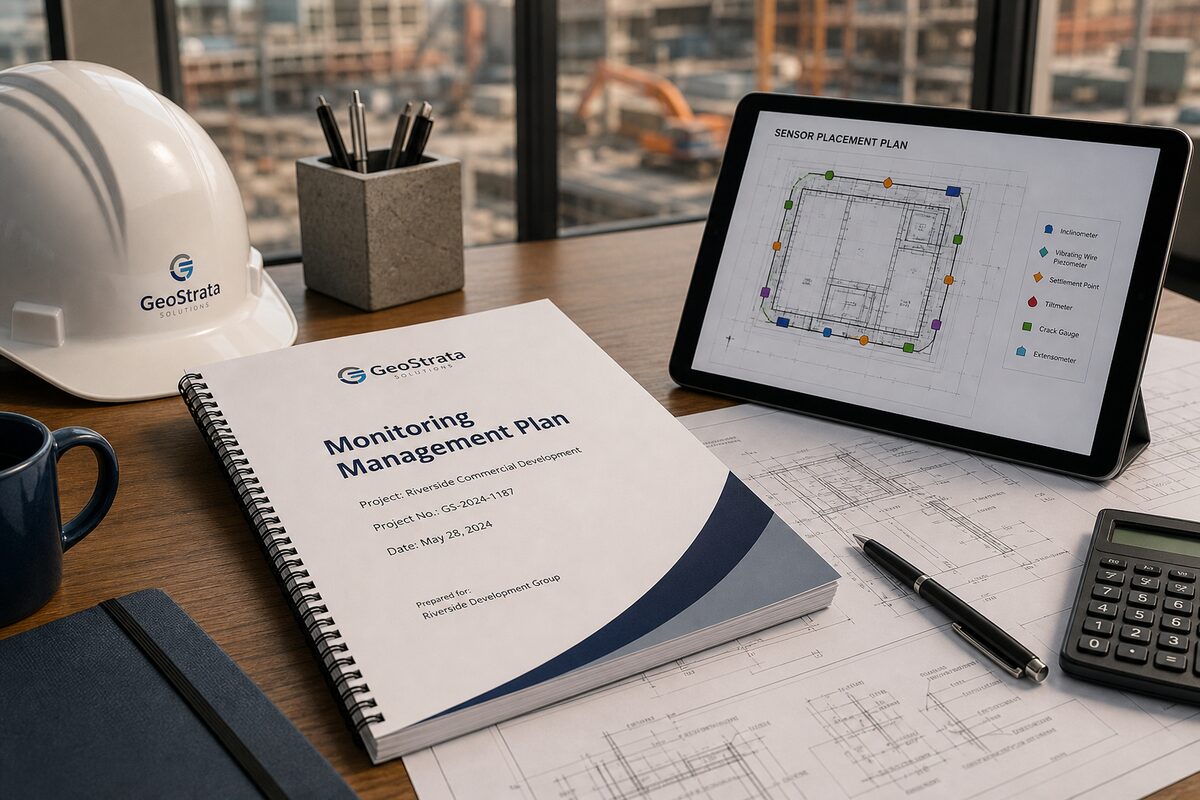
A monitoring management plan (MMP) is the governing document that defines how a construction or infrastructure monitoring programme operates from sensor deployment through to data archiving and final reporting. It is not a specification document for sensor hardware, nor is it a generic environmental management sub-plan. An MMP establishes the rules of the programme: what is being measured, against what threshold, by what method, and who acts when a limit is approached or exceeded. On Queensland projects, principal contractors increasingly encounter MMP requirements as a condition of development approval, a prerequisite for TMR works approval under MRTS, or as a contractual obligation from a building owner undertaking adjacent excavation or demolition.
The distinction between an MMP and a construction monitoring specification matters in practice. A monitoring specification describes the technical requirements for instruments and installation methods: geophone sensitivity, accelerometer frequency response, sound level meter class, data logger resolution, and calibration intervals. An MMP references or incorporates those specifications but operates at a higher level, addressing programme governance, stakeholder obligations, response procedures, and sign-off authority. Many projects carry detailed specifications with no MMP, which means they have instrumentation in the ground but no agreed escalation path when a threshold is breached. Regulators and insurers are increasingly aware of this gap.
When a Project Requires an MMP
Not every construction activity warrants a formal MMP, but the threshold for when one is necessary is lower than most project managers assume. The following circumstances typically trigger an MMP requirement on Queensland projects:
- Development approval conditions: : DA conditions issued by Brisbane City Council (BCC), local government, or assessed under the Planning Act 2016 may explicitly require an MMP as a pre-commencement deliverable, particularly for basement excavations near existing structures or sites with SARA referral obligations.
- TMR corridor works: : Projects within or adjacent to state-controlled roads under TMR jurisdiction require monitoring programmes consistent with MRTS standards. TMR's standard conditions for works approvals routinely require documented alert and alarm thresholds with defined response protocols.
- Environmentally sensitive sites: : Works triggering Environmental Authority (EA) conditions under the Environmental Protection Act 1994, or projects with EPBC Act referral obligations, will require monitoring governance documentation covering noise, dust, and vibration at defined sensitive receptors.
- Queensland Rail (QR) interface: : Any project within QR's corridor or near rail infrastructure requires a monitoring plan with RPEQ endorsement as a standard interface condition.
- Structural risk adjacent to existing buildings: : Where geotechnical assessment identifies risk of differential settlement, retained structure movement, or ground movement affecting neighbouring properties, an MMP provides the contractual and technical framework for managing that risk through the construction programme.
- Voluntary risk management: : Sophisticated developers and building owners sometimes commission an MMP in the absence of a regulatory requirement, particularly for high-value or occupied assets where litigation exposure from vibration or settlement damage is a real concern.
Structure of a Monitoring Management Plan
A well-structured MMP follows a logical order from programme objectives through to close-out. The core sections are described below.
1. Programme Scope and Objectives
This section defines what the monitoring programme exists to achieve. It identifies the asset or assets being protected, the activities that create the hazard (blasting, piling, excavation, surcharge loading), and the parameters being monitored. Typical parameters include peak particle velocity (mm/s PPV) for vibration, A-weighted equivalent sound pressure level dB(A) Leq for construction noise, PM10 and PM2.5 concentrations in µg/m³ for dust, tilt in degrees or millidegrees for structural rotation, crack width in millimetres for existing defects, and angular distortion or differential settlement expressed in microstrain for structural monitoring of framed buildings.
The scope section also establishes the monitoring period, typically tied to construction programme phases rather than a fixed calendar date. This prevents the common problem of monitoring stopping before a high-risk activity is complete.
2. Applicable Standards and Threshold Basis
Every threshold in an MMP requires a technical and regulatory basis. Referencing the correct standard for each monitored parameter is not a formality; it defines what the numbers mean and how they are to be applied.
Key standards routinely referenced in Queensland MMPs include:
- AS 2187.2-2006: : Explosives storage and use, including the vibration limits for blasting expressed as PPV at defined distances and frequencies.
- DIN 4150-3 (1999): : German standard widely applied in Australia for continuous (non-blast) construction vibration, providing frequency-dependent velocity limits for different building categories. Limits typically range from 3 mm/s PPV for sensitive heritage structures up to 20 mm/s PPV for industrial buildings under short-term vibration.
- BS 7385-2 (1993): : British standard for building response to vibration, providing a complementary reference to DIN 4150-3 particularly for residential and commercial structures.
- AS/NZS 2107:2016: : Recommended design sound levels and reverberation times for building interiors, used when assessing noise impacts on occupied buildings.
- AS 3580 series: : Methods for sampling and analysis of ambient air, governing dust monitoring methodology and instrument requirements for nephelometers, beta attenuation monitors, and gravimetric samplers.
- AS 1055 series: : Acoustics and description of noise in the environment, providing the measurement framework for environmental noise assessment.
- Environmental Protection (Noise) Policy 2019 (Qld): : Sets the statutory noise limits for construction activity at sensitive receptors in Queensland, forming the primary basis for noise thresholds in Brisbane and South East Queensland projects.
The MMP should also document any project-specific limits imposed by the regulator or asset owner that are more stringent than the standard default values. Heritage-listed structures, hospitals, and precision manufacturing facilities often carry tighter limits that must be explicitly captured.
3. Sensor Network Design
The sensor network section translates the programme objectives into a physical instrumentation layout. This section should be specific enough that a field technician could deploy the network from the document alone.
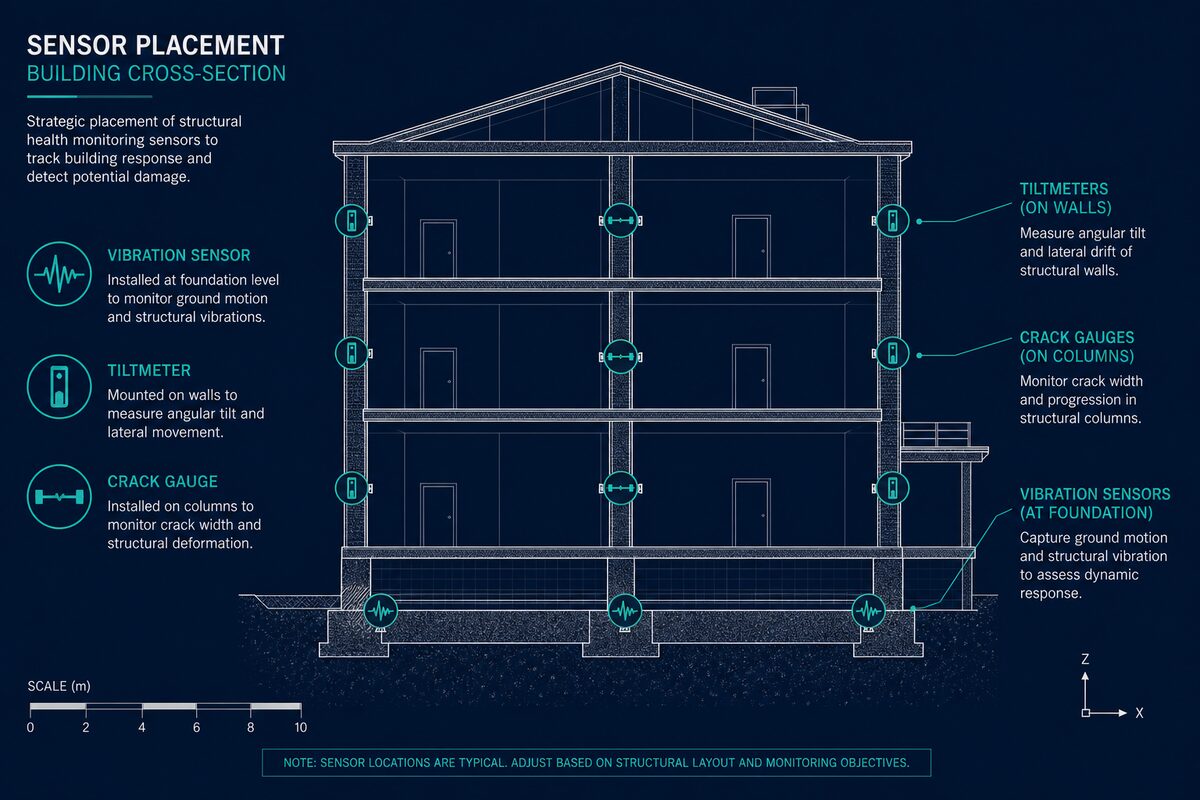
For vibration monitoring, triaxial geophones or MEMS accelerometers are deployed at sensitive receiver locations, typically at the base of external walls or at ground level adjacent to the foundation of the asset under protection. Sensor selection depends on the frequency range of interest and the PPV range expected. Geophones with a natural frequency of 4.5 Hz suit blast monitoring well; MEMS accelerometers with flat response down to 0.1 Hz are better suited for continuous low-frequency monitoring from piling or heavy plant. The MMP should specify instrument type, mounting method, sampling rate (typically 1,024 Hz or higher for blast events), and the triggering threshold for event capture.
For structural settlement and tilt monitoring, the network design references established survey datums, identifies monitoring points on the structure (column bases, slab edges, retaining wall capping), and specifies the instrument type. Automated total stations, tiltmeters calibrated to 0.001-degree resolution, and electrolevel systems are all used depending on the required accuracy and monitoring frequency. The baseline measurement protocol, the number of baseline readings required before work commences, and the permitted interval between readings during active construction phases should all be stated.
For noise and dust, the MMP defines receptor locations for Class 1 or Class 2 sound level meters (as classified under IEC 61672), nephelometers or beta attenuation monitors for continuous dust measurement, and any supplementary meteorological instrumentation required to contextualise results against wind speed and direction.
The network design should also address data communications: whether instruments report via 4G LTE to a cloud-based monitoring platform, what the data acquisition interval is, and how data is stored and backed up.
4. Threshold Definitions: Alert, Alarm, and Action Levels
This is the operational core of the MMP. A well-designed threshold structure uses three levels, each triggering a different response.
- Alert level: : Typically set at 75-80% of the regulatory or project limit. Reaching an alert level does not require a work stoppage but triggers increased monitoring frequency, notification to the site supervisor, and a review of activity levels or work methods. For example, an alert level for continuous vibration might be set at 3.0 mm/s PPV where the regulatory limit is 5.0 mm/s PPV.
- Alarm level: : Set at or near the regulatory or contractual limit. Reaching an alarm level triggers immediate notification of the project manager, engineer, and asset owner representative. Work may continue but must be reviewed against the monitoring data before proceeding with the activity that caused the exceedance.
- Action level: : Set at or above the regulatory limit, or at a level indicating potential structural risk. An action level exceedance triggers an immediate work suspension, escalation to the RPEQ, and potentially notification of the regulator or asset owner in writing. Work does not resume until the RPEQ has assessed the data and authorised restart.
Threshold values must be specific to each monitored parameter and each sensor location. A single vibration limit applied uniformly across all sensors on a site with a mix of heritage masonry and modern reinforced concrete frames is not technically defensible.
5. Alert Escalation and Response Protocols
The escalation section converts threshold definitions into human action. It answers the question: when the monitoring platform sends an alarm, who receives it, when do they receive it, and what are they required to do?
The MMP should include a contact register with primary and secondary contacts for each role: site supervisor, project manager, principal contractor's representative, monitoring engineer, RPEQ, asset owner or occupant, and where relevant, the regulatory contact at BCC, TMR, DES, or SARA. Contact details, preferred notification method (automated SMS, email, phone call), and maximum response times should be stated explicitly.
Response procedures for each threshold level should be documented as a flow chart or decision matrix. The intent is that a site supervisor receiving an alarm notification at 6 am can follow the protocol without needing to make judgement calls about who to call or whether work should stop.
6. Reporting Cadence and Format
Reporting obligations vary by project. The MMP should define the following reporting outputs:
- Real-time dashboard access: : Most modern IoT monitoring platforms provide a web-based or app-based interface. The MMP should identify who has access, what data is visible, and how data is presented against thresholds.
- Daily or shift reports: : Automated summary reports generated from the monitoring platform, covering all events recorded in the period, peak readings at each sensor, and any threshold exceedances.
- Weekly or fortnightly summary reports: : Engineer-reviewed reports summarising monitoring data against programme activities, noting any trends or anomalies, and confirming compliance with applicable limits. These are the primary record for regulatory compliance purposes.
- Exceedance reports: : Standalone reports generated within a defined timeframe (typically 24-48 hours) following any alarm or action level event. These document the event, the data, the response taken, and the outcome.
- Final close-out report: : A programme-level summary produced at project completion documenting the full monitoring dataset, compliance record, and any residual issues.
All reports should carry the monitoring engineer's professional identification. Reports forming part of a regulatory compliance record or submitted to a government body should carry RPEQ sign-off.
7. RPEQ Sign-Off Requirements
In Queensland, a Registered Professional Engineer of Queensland (RPEQ) under the Professional Engineers Act 2002 carries statutory responsibility for professional engineering services. For a monitoring programme, RPEQ involvement is typically required at several points: the MMP itself as a programme document, the sensor network design if it involves structural assessment or geotechnical interpretation, any action level exceedance assessment, and the final close-out report.
The MMP should clearly identify the RPEQ responsible for the programme, their registration number, the scope of their engineering responsibility, and the circumstances requiring their direct involvement. This protects the principal contractor, clarifies the client's obligations, and provides regulators with an identifiable professional accountable for the programme's technical adequacy.
8. Programme Administration: Calibration, Maintenance, and Archiving
An MMP is a live document for the duration of the construction programme. The administration section covers instrument calibration intervals (typically annually for sound level meters per IEC 61672, and before and after deployment for vibration instruments), field calibration checks, maintenance visit frequency, procedures for handling sensor faults or data gaps, and the data archiving protocol at programme close-out.
Data archiving requirements vary. Regulatory compliance data should be retained for a minimum period consistent with the relevant environmental authority conditions, typically five to seven years. Structural monitoring data supporting design or litigation risk management should be retained for the life of the structure or the relevant limitation period under Queensland's Limitation of Actions Act 1974.
MMP vs. Construction Monitoring Specification
The practical difference between these two documents is worth restating clearly. A construction monitoring specification is a technical document: it tells you what instrument to use and how to install it. An MMP is a governance document: it tells you what to do with the data and who is responsible when something goes wrong. Projects that carry only a specification have defined the instrumentation but have not defined the programme. Projects that carry only an MMP without a supporting specification risk ambiguity in how instruments are selected, calibrated, and deployed.
On well-managed projects, the two documents co-exist and are cross-referenced. The specification is typically an appendix or referenced document within the MMP, ensuring that the governance framework and the technical requirements are version-controlled together.
Conclusion
A monitoring management plan is the document that converts instrumentation into a defensible programme. Without it, sensor networks generate data that no-one is obligated to act on, thresholds exist without agreed response procedures, and the chain of accountability from field instrument to RPEQ to regulator is broken. On Queensland projects subject to DA conditions, TMR approval, QR interface, or Environmental Authority requirements, a properly structured MMP is not optional. Even where it is not mandated, it represents sound risk management practice for any project where vibration, noise, dust, or structural movement poses a credible risk to adjacent assets or sensitive receptors. Oculus Technology prepares and administers monitoring management plans across structural health monitoring, construction vibration, and environmental monitoring programmes. Further information is available at [oculustech.au/services/monitoring-management-plans](https://oculustech.au/services/monitoring-management-plans).
Need monitoring for your project?
Share your site context, approval conditions, and project timeline. We'll respond with a practical monitoring scope within 24 hours.
Request a Scope