How Much Does Construction Monitoring Cost in Australia? 2026 Guide
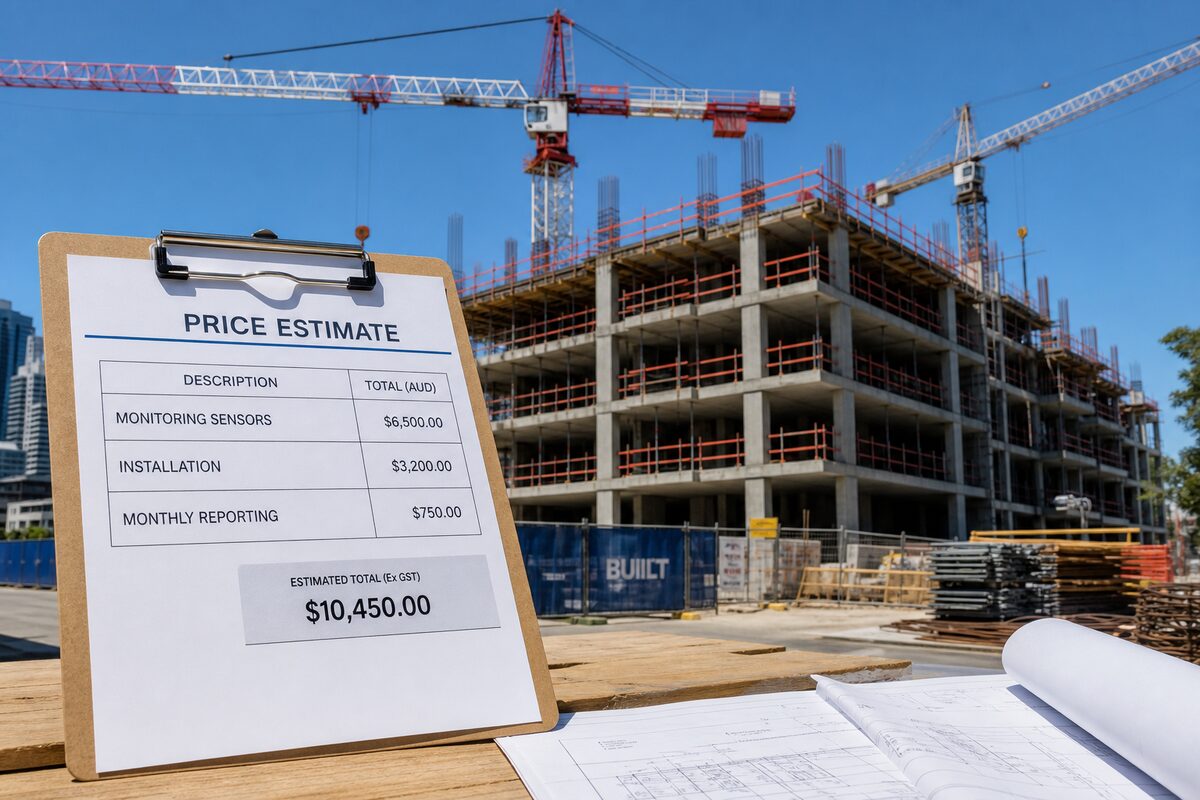
Construction monitoring costs in Australia vary more than most project managers expect, and the gap between the cheapest quote and a properly engineered programme can be substantial. A single vibration monitor placed at a site boundary for two weeks looks nothing like a multi-point structural health monitoring network running across a 12-month demolition and rebuild programme. Both are described as "construction monitoring" in tender documents, but they carry fundamentally different risk profiles, data obligations, and price points. Understanding what drives cost helps asset owners, principal contractors, and developers evaluate quotes accurately rather than defaulting to the lowest number.
The regulatory environment adds further complexity. In Queensland, development approval conditions issued under the Planning Act 2016 routinely specify monitoring obligations tied to environmental authority requirements from DES, noise and vibration limits referenced in TMR's MRTS specifications, and structural protection conditions attached to approvals near Queensland Rail corridor assets or SARA-referable development. Getting the scope wrong at tender stage means either over-spending on unnecessary equipment or, more commonly, deploying an underpowered programme that fails to meet compliance obligations when an incident occurs.
This article breaks down the pricing components that make up a construction monitoring quote in 2026, explains what each component covers, and outlines what a properly structured monitoring programme should include before you sign off on a scope of works.
The Core Pricing Variables
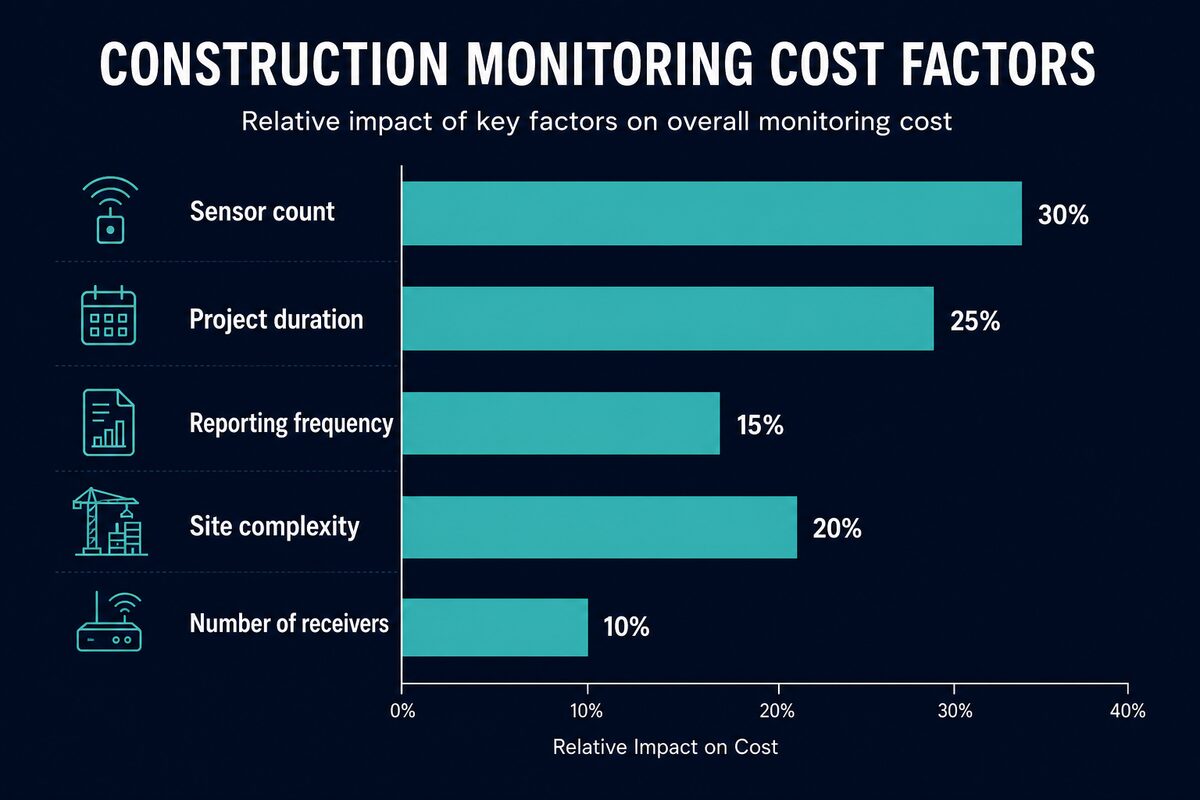
Construction monitoring pricing is driven by four compounding variables: the number and type of sensors deployed, the duration of the monitoring period, the frequency of data reporting and review, and the level of engineering analysis required. These variables interact, meaning a short-duration project with high reporting frequency can cost as much as a long-duration project with periodic reporting.
- Sensor count and type:: A triaxial geophone measuring peak particle velocity (PPV) in mm/s costs less to deploy and maintain than a MEMS accelerometer array feeding a structural health monitoring system. Tiltmeters, crack gauges, piezometers, settlement plates, Type 1 sound level meters, and nephelometers each carry different hardware costs and calibration requirements.
- Monitoring duration:: Day-rate and month-rate equipment hire structures mean unit costs drop over longer programmes, but total cost increases with duration. A 6-month programme will always cost more in absolute terms than a 4-week programme, even if the daily rate is lower.
- Reporting frequency:: Real-time automated alerts cost less per event than manually prepared engineering reports, but the infrastructure to support real-time monitoring (cellular-connected dataloggers, cloud platforms, alarm thresholds) adds to the base deployment cost.
- Engineering interpretation:: Placing a sensor is not the same as interpreting what it records. RPEQ-signed monitoring reports, exceedance investigations, and compliance submissions to SARA, BCC, or DES carry professional fees that are separate from equipment hire.
Vibration Monitoring Cost Breakdown
Vibration monitoring against AS 2187.2 or DIN 4150-3 is the most common construction monitoring service requested in Australia, typically triggered by blasting, pile driving, compaction, or demolition near sensitive structures or heritage buildings.
Equipment Hire Rates
In 2026, standalone vibration monitor hire in Australia typically ranges from $150 to $350 per unit per day for short-duration deployments, with significant reductions for weekly and monthly rates. A monthly rate of $1,800 to $3,500 per unit is a reasonable market benchmark for a quality triaxial geophone instrument with onboard logging, cellular connectivity, and cloud data access. These figures apply to instruments meeting the instrument specifications referenced in AS 2187.2 Appendix J.
Multi-unit deployments attract volume discounts. A 4-unit network hired for three months would typically cost between $18,000 and $35,000 for equipment alone, depending on the instrument specification and provider.
Deployment and Commissioning
Site mobilisation, sensor installation, and commissioning represent a fixed cost regardless of programme duration. Expect to pay between $2,000 and $6,000 per mobilisation event for a qualified monitoring technician to install, configure, and baseline-calibrate a vibration monitoring network. This cost includes setting alarm thresholds against the applicable standard limits, such as the 5 mm/s PPV limit for commercial structures or the 2 mm/s PPV limit for heritage-listed buildings commonly referenced in Queensland development approval conditions.
Reporting and Engineering Fees
Automated daily or weekly data summaries delivered through a web portal carry minimal additional cost once the infrastructure is in place. What adds cost is engineering interpretation: reviewing exceedances, preparing RPEQ-signed compliance reports for submission to a regulator, or attending site to investigate an anomalous event. Engineering time for report preparation typically runs at $180 to $280 per hour depending on the seniority of the engineer and the complexity of the analysis required.
A monthly vibration compliance report for a mid-complexity project might require 4 to 8 hours of engineering time, placing monthly reporting costs between $720 and $2,240 in professional fees, in addition to equipment hire.
Structural Monitoring Programme Costs
Structural monitoring programmes for buildings adjacent to excavation, tunnelling, or demolition are more involved and correspondingly more expensive. These programmes typically combine multiple sensor types to capture different response modes.
Sensor Types and Indicative Hire Rates (Monthly)
- Crack gauges (vibrating wire or digital):: $80 to $150 per unit per month
- Tiltmeters (uniaxial or biaxial):: $200 to $400 per unit per month
- Settlement monitoring points (prism targets for total station or LiDAR):: $40 to $90 per point per month
- MEMS accelerometers (for dynamic structural response):: $250 to $500 per unit per month
- Automated total stations (ATS) for deformation monitoring:: $3,500 to $7,000 per unit per month including software licensing
A 20-point network combining crack gauges, tiltmeters, and prism targets for a building protection programme during a neighbouring basement excavation might carry equipment hire costs of $8,000 to $15,000 per month before any engineering or reporting fees are applied.
Pre-Construction Condition Surveys
A structural monitoring programme for a third-party asset almost always begins with a pre-construction condition survey, which establishes a documented baseline against which claims and exceedances are assessed. Condition surveys for a single residential property typically cost $1,500 to $3,500. For a multi-storey commercial building or heritage-listed structure, expect $5,000 to $15,000 depending on floor count, complexity, and whether photographic documentation alone is sufficient or if LiDAR reality capture is specified.
LiDAR-based condition surveys using a terrestrial laser scanner produce millimetre-accurate point clouds that provide irrefutable before-and-after comparisons. These surveys carry higher upfront cost but reduce dispute risk substantially on high-value adjacent assets.
Noise and Dust Monitoring Costs
Environmental monitoring for noise and dust is frequently required under environmental authority conditions issued by DES or Brisbane City Council, or under EPBC Act approvals for projects near sensitive ecological receptors.
Noise Monitoring
Attended noise measurements using a Type 1 sound level meter for a single site visit typically cost $800 to $1,800, depending on the duration of measurement required and the distance between measurement locations. Continuous unattended noise monitoring using a Type 1 or Type 2 instrument with cellular data logging runs at $1,200 to $2,500 per unit per month for equipment hire. Reporting against AS/NZS 2107 or the relevant EPA noise policy limits adds engineering fees in the same range described above for vibration monitoring.
Dust Monitoring
PM10 and PM2.5 dust monitoring using nephelometers or beta attenuation monitors (BAM) is required on projects with significant earthworks or demolition scope near sensitive receptors. Nephelometer hire typically runs $1,500 to $3,000 per unit per month. Beta attenuation monitors, which provide regulatory-grade concentration data in µg/m³, are more expensive at $3,500 to $6,000 per unit per month due to the instrument's internal complexity and calibration requirements. Where AS 3580 compliance is required, BAM data is generally preferred by regulators over optical scatter methods.
What Drives Cost Higher Than Expected
Several programme characteristics reliably push total cost beyond initial estimates, and these are worth identifying before scope is finalised.
- Remote or difficult-access sites:: Instrument installation requiring elevated work platforms, confined space access, or helicopter mobilisation adds significant cost to the deployment phase.
- Real-time alert requirements:: Programmes requiring automated SMS or email alerts when thresholds are breached need reliable cellular coverage, redundant power (solar or battery backup), and more frequent data validation checks. Connectivity infrastructure can add $500 to $1,500 per monitoring point to the setup cost.
- Regulatory submission requirements:: When monitoring data must be submitted to SARA, DES, or TMR in a specified format, the engineering effort required to compile, quality-check, and package submissions is greater than for internal-only reporting.
- High change rates on site:: Active construction sites with changing work zones require periodic instrument relocations, re-calibration, and updated alarm threshold assessments. Each relocation event typically costs $500 to $2,000 in technician time and travel.
- Third-party asset owners:: Monitoring programmes protecting assets owned by Queensland Rail, BCC, or private third parties often require additional coordination, access negotiation, and written reporting to the asset owner's specification, all of which adds professional time.
What a Proper Monitoring Programme Quote Should Include
A monitoring quote that omits scope items may appear cheaper but creates risk for the principal contractor when gaps are discovered during delivery. A properly structured quote should explicitly address the following components.
Scope Definition
The quote should identify: which assets are being monitored, which construction activities trigger monitoring obligations, the applicable standards or development approval conditions, and the spatial extent of the monitoring network. Vague scoping language like "monitoring as required" is not adequate for budget control or compliance purposes.
Equipment Schedule
A line-item equipment schedule listing each sensor type, quantity, hire rate, and hire period allows the client to understand what they are paying for and compare quotes from multiple providers on a like-for-like basis. This schedule should reference instrument specifications, including whether sound level meters are Type 1 or Type 2, whether vibration instruments meet AS 2187.2 requirements, and whether dust instruments are capable of delivering results against AS 3580.
Deployment and Demobilisation
Installation, commissioning, calibration, and decommissioning should be itemised separately from equipment hire. These are fixed costs that apply regardless of programme duration and should not be hidden within daily or monthly hire rates.
Data Management and Access
The quote should specify how data is stored, for how long, and who has access. On projects with regulatory obligations, data retention for a minimum of seven years is standard practice. Real-time portal access, automated threshold alerts, and data export formats should all be described.
Reporting Deliverables
The reporting schedule should specify: report type (automated summary, engineering compliance report, RPEQ-signed submission), frequency (daily, weekly, monthly, event-triggered), and the professional fees associated with each report type. Exceedance investigation reports are typically priced separately as they require reactive engineering work outside the routine reporting schedule.
Assumptions and Exclusions
A well-structured quote lists the assumptions made during pricing, such as site access availability, cellular coverage adequacy, or client provision of power to instrument locations. Exclusions should be explicit: if traffic management for instrument installation is not included, that should be stated, not discovered on site.
Indicative Total Programme Costs
To give a practical reference point, the following ranges reflect typical programme costs for common project types in Queensland in 2026. These are indicative only and will vary with project-specific requirements.
- Single-point vibration monitoring, 4 weeks, automated reporting:: $4,000 to $9,000 total
- 4-point vibration and noise monitoring network, 3 months, monthly compliance reports:: $25,000 to $55,000 total
- Building protection programme (20-point structural network) for 6-month basement excavation:: $80,000 to $160,000 total
- Full construction monitoring programme including vibration, noise, dust, and structural monitoring across a 12-month urban civil project:: $200,000 to $450,000+ total
These ranges assume Queensland-based projects with standard site access. Projects in regional or remote locations, or those with complex regulatory obligations, will sit at the higher end or above these ranges.
Evaluating a Monitoring Quote
When comparing quotes for construction monitoring, the lowest price is rarely the most defensible choice. A monitoring programme that fails to capture an exceedance event, lacks RPEQ-signed reports required by a development approval condition, or uses instruments that do not meet the specification referenced in the applicable standard exposes the principal contractor to cost and liability that far exceeds the saving made at tender.
The questions worth asking of any monitoring provider include: Is the equipment calibrated to the relevant standard? Who signs the engineering reports and what is their registration status? What happens when an instrument fails mid-programme? Is data hosted on Australian servers and retained for the required period? Can the provider produce evidence of similar programme delivery in your project's regulatory context?
Conclusion
Construction monitoring cost in Australia in 2026 is not a fixed commodity price. It is a function of sensor count, instrument specification, programme duration, reporting obligations, and engineering input, all of which should be explicitly scoped before a price is agreed. A properly structured monitoring programme protects the principal contractor from compliance gaps, provides defensible data in the event of third-party claims, and satisfies regulatory requirements set by DES, SARA, TMR, BCC, and other bodies relevant to Queensland construction. Treating monitoring as a commodity procurement decision rather than an engineered service is where cost surprises originate.
Oculus Technology prepares monitoring programme scopes, equipment schedules, and RPEQ-signed compliance reporting for construction projects across Queensland and nationally. Contact our team or visit [oculustech.au/services/construction-monitoring](https://oculustech.au/services/construction-monitoring) to discuss your project requirements.
Need monitoring for your project?
Share your site context, approval conditions, and project timeline. We'll respond with a practical monitoring scope within 24 hours.
Request a Scope