DIN 4150-3: Building Vibration Criteria and How Australia Uses It
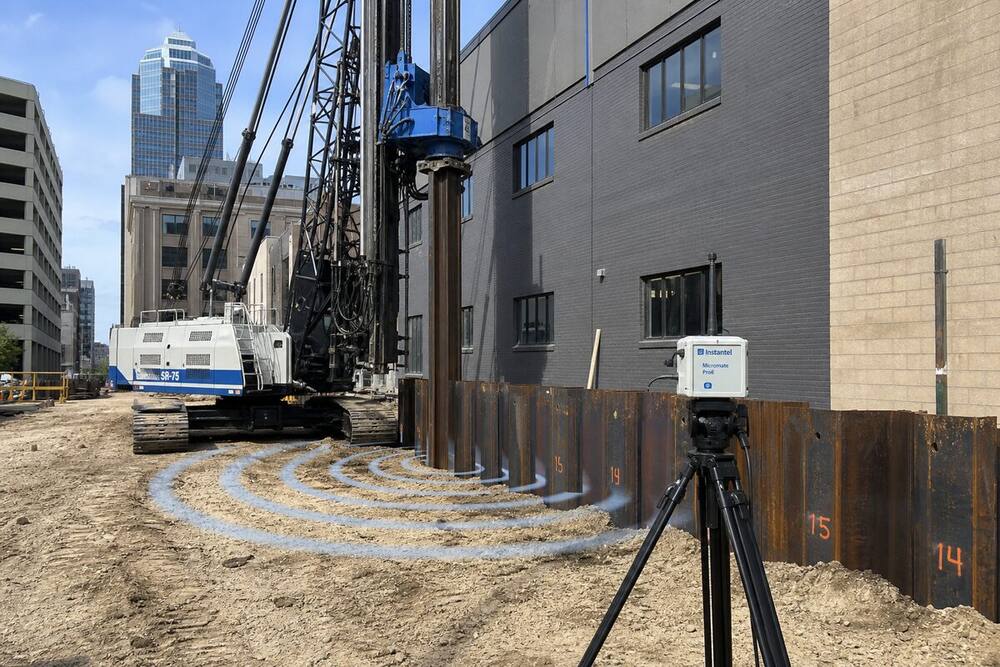
Construction vibration assessment in Australia sits at an intersection of standards from three different jurisdictions: domestic, British, and German. Of these, DIN 4150-3 has become the most widely referenced benchmark for evaluating whether ground-borne vibration from construction activity poses a risk of damage to adjacent structures. Despite being a German standard, it appears routinely in development approval conditions issued by Brisbane City Council, SARA, TMR, and Queensland's Department of Environment and Science. Its adoption is not accidental. The standard's frequency-dependent limit framework directly addresses the relationship between vibration character and building response in a way that flat-limit approaches do not.
The practical question on any construction site with blasting, pile driving, rock breaking, or heavy compaction is simple: at what level does vibration transition from nuisance to a credible structural risk? DIN 4150-3 answers that question through a tiered classification of building types and a velocity spectrum that accounts for how different frequencies couple with structural components. Australian engineers apply it alongside AS 2187.2-2006 (the primary domestic standard for blasting vibration) and BS 7385-2:1993, which shares similar principles but uses slightly different limit tables. Understanding how these three standards interact is essential for anyone managing vibration monitoring obligations on a Queensland construction project.
What DIN 4150-3 Actually Specifies
DIN 4150-3, formally titled *Erschütterungen im Bauwesen - Teil 3: Einwirkungen auf Bauwerke* (Structural Vibration Part 3: Effects on Structures), was published by the Deutsches Institut für Normung and addresses the effects of short-term and long-term vibration on buildings. The standard defines vibration in terms of peak particle velocity (PPV), measured in mm/s, and establishes limits based on two criteria: the frequency of vibration and the structural classification of the affected building.
The standard distinguishes between transient (impulsive) vibration events, such as those from blasting or impact pile driving, and continuous or intermittent sources such as vibratory compaction or traffic. This distinction matters because structural response to a short-duration, high-peak event differs from cumulative fatigue effects under sustained lower-level vibration. DIN 4150-3 addresses both scenarios with separate guidance tables and commentary on measurement interpretation, which is one reason it is preferred by specialist vibration engineers over simpler, single-value criteria.
Measurement under DIN 4150-3 is conducted at the foundation level of the affected structure, or at the base of the outer wall nearest the vibration source. This is the point at which ground-borne energy transfers into the building fabric. Triaxial geophones or MEMS accelerometers recording three orthogonal velocity channels (vertical, transverse, horizontal-longitudinal) are used to capture PPV across each axis. The governing value is the highest recorded PPV across all three channels at the measurement point.
Frequency-Dependent PPV Limits by Building Class
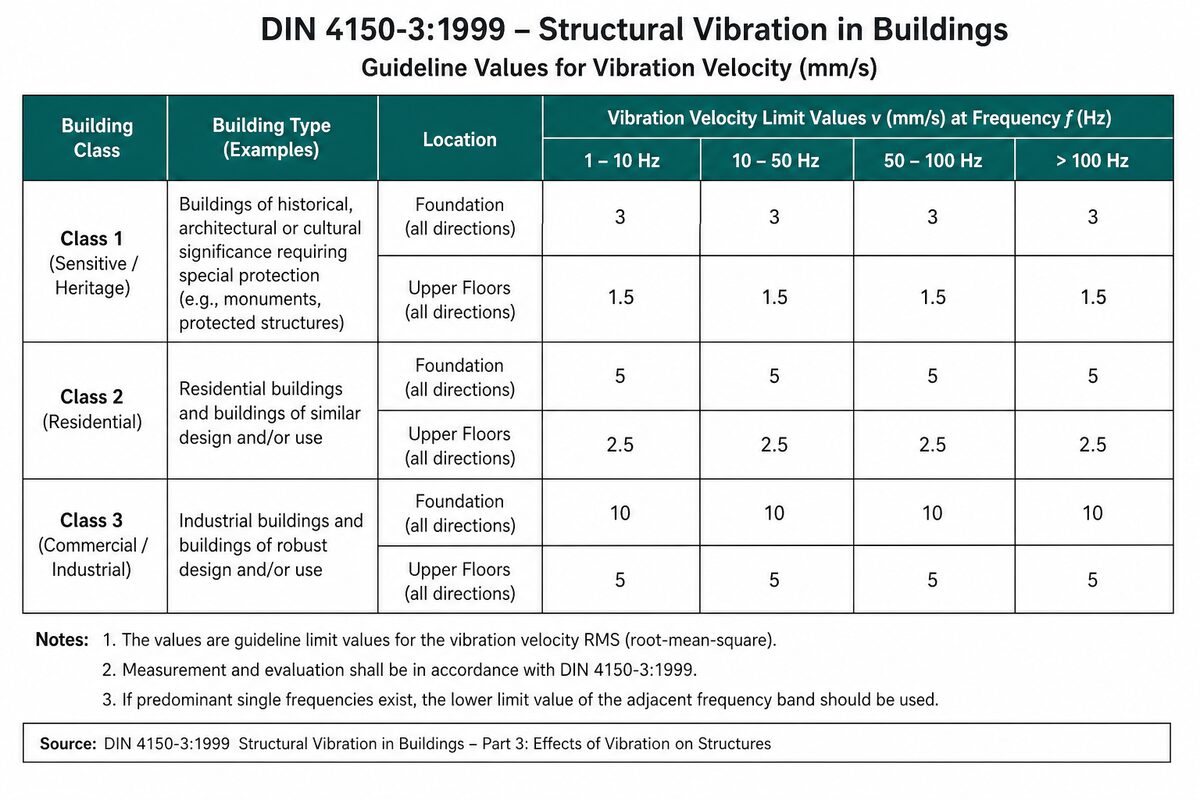
The core of DIN 4150-3 is Table 1, which sets PPV limits as a function of vibration frequency and building classification. The standard defines three primary building categories for short-term vibration assessment:
- Line 1 - Industrial and commercial structures:: Buildings used for trade or industry, including reinforced concrete frames, steel structures, and engineered industrial facilities.
- Line 2 - Residential buildings and structures of similar design:: Standard residential construction, apartment buildings, offices, and comparable masonry or framed structures built to modern or recent codes.
- Line 3 - Structures sensitive to vibration:: Heritage-listed buildings, older masonry construction without engineered foundations, buildings with pre-existing cracking or deterioration, and structures specifically identified as requiring conservative treatment.
For Line 1 (industrial/commercial), the standard permits:
- PPV of 20 mm/s: at frequencies of 10 Hz and below
- PPV of 20 to 40 mm/s: across the 10 to 50 Hz range (linearly interpolated)
- PPV of 40 mm/s: at frequencies above 50 Hz
For Line 2 (residential), the limits are considerably lower:
- PPV of 5 mm/s: at frequencies of 10 Hz and below
- PPV of 5 to 15 mm/s: across the 10 to 50 Hz range
- PPV of 15 mm/s: at frequencies above 50 Hz
For Line 3 (heritage and sensitive structures), the limits are the most conservative:
- PPV of 3 mm/s: at frequencies of 10 Hz and below
- PPV of 3 to 8 mm/s: across the 10 to 50 Hz range
- PPV of 8 mm/s: at frequencies above 50 Hz
The frequency dependency reflects a physical reality: low-frequency vibration couples more efficiently with the natural resonant frequencies of most building structures, which typically fall in the 1 to 10 Hz range for whole-building modes and 10 to 30 Hz for individual floor and wall panels. At higher frequencies, the energy attenuates more rapidly through building components, reducing the risk of resonant amplification and concentrated stress.
Long-Term Vibration: The Floor Vibration Criterion
DIN 4150-3 also addresses sustained or repeated vibration through a separate assessment pathway. For continuous or intermittent sources, the standard references measurement at the uppermost floor of the building rather than at foundation level, because floor response amplification is the key concern for occupant perception and fatigue-related damage under long-term exposure.
The floor vibration limits are expressed as a single-value PPV regardless of frequency for each building class. For residential structures under long-term continuous vibration, DIN 4150-3 recommends a threshold of 2.5 mm/s at the uppermost floor. For industrial and commercial premises, this rises to 10 mm/s. These values are used when assessing sustained activities such as tunnel boring machine (TBM) operations, continuous sheet pile pressing, or ongoing heavy traffic vibration that will persist throughout a construction programme spanning weeks or months.
This two-pathway approach makes DIN 4150-3 genuinely useful for programme-scale monitoring, not just event-by-event blast assessment. An urban infrastructure project using a TBM, for example, will need to track cumulative floor vibration response at sensitive receivers over the entire drive duration, not just capture peak events.
How AS 2187.2 Sits Alongside DIN 4150-3
AS 2187.2-2006, *Explosives - Storage and Use Part 2: Use of Explosives*, is the primary Australian standard governing blasting operations. Its vibration criteria are specifically calibrated to explosive-sourced ground vibration and define PPV limits relative to the dominant frequency of the blast wave, using a similar frequency-banded approach to DIN 4150-3.
Under AS 2187.2, the general limits for residential structures are:
- 5 mm/s PPV: for frequencies below 10 Hz
- 10 mm/s PPV: for frequencies between 10 and 70 Hz
- 10 mm/s PPV: above 70 Hz (with allowance for site-specific variations)
These values align closely with the DIN 4150-3 Line 2 limits at the lower frequency range but are somewhat more permissive at mid-range frequencies. AS 2187.2 also includes a probability-of-exceedance framework, allowing for a limited number of monitored events to exceed the guideline limit provided a statistical analysis of the blasting programme demonstrates compliance at a 95th-percentile confidence level. This is a practically important provision for large quarrying or civil construction operations.
The reason both standards are applied together in Australian practice is that AS 2187.2 governs blasting specifically, while DIN 4150-3 covers all construction vibration sources including mechanical plant. A project involving both controlled blasting and rock breaking with a hydraulic hammer will typically be subject to AS 2187.2 for blast events and DIN 4150-3 for mechanical rock breaking, with the environmental authority or approval body specifying which applies to which activity.
BS 7385-2 and the Triangulated Approach
BS 7385-2:1993, *Evaluation and Measurement for Vibration in Buildings Part 2: Guide to Damage Levels from Groundborne Vibration*, is the British equivalent and shares the frequency-dependent PPV framework. Its limit tables use similar frequency bands and building classifications to DIN 4150-3, though with some differences in the mid-frequency interpolation zones and in how it categorises construction types.
Where BS 7385-2 adds value alongside DIN 4150-3 is in its explicit guidance on cosmetic versus structural damage thresholds. The standard defines:
- Cosmetic damage threshold:: The level at which superficial cracking of plaster or render may occur, beginning at approximately 15 mm/s PPV for residential construction at frequencies above 15 Hz.
- Minor structural damage threshold:: The level at which non-load-bearing elements may be affected, typically commencing above 50 mm/s PPV for engineered residential structures.
- Major structural damage:: Requiring PPV levels well above 100 mm/s that are effectively unachievable under normal construction operations.
This damage classification is useful for communicating risk to developers, principal contractors, and building owners. When pre-construction condition surveys identify pre-existing cracking in adjacent buildings, being able to reference BS 7385-2's cosmetic damage threshold helps define the monitoring trigger level and the alert/alarm thresholds set in the site's vibration monitoring plan.
In Queensland practice, it is common to see approval conditions that reference DIN 4150-3 as the primary limit standard and BS 7385-2 as the interpretive framework for damage assessment, with AS 2187.2 called up specifically for blasting activities. Geotechnical specialists and vibration engineers working for TMR or BCC-regulated projects are generally expected to demonstrate familiarity with all three documents.
Applying the Standards in the Field
Instrumentation Requirements
Monitoring to DIN 4150-3 requires triaxial vibration sensors capable of capturing the full frequency range of construction-induced ground motion, typically 1 to 300 Hz. Triaxial geophones with a natural frequency of 4.5 Hz or lower are standard for construction monitoring. On sites where low-frequency TBM or vibratory compaction sources are the primary concern, 1 Hz geophones are preferable to avoid roll-off errors below the instrument's natural frequency.
Data acquisition systems must record true PPV per channel and log the dominant frequency of each event to enable frequency-band compliance assessment. Systems that only record a broadband PPV without frequency content are insufficient for DIN 4150-3 compliance reporting. Modern cloud-connected vibration monitors used in Queensland deployments transmit waveform data in real time, allowing immediate assessment against the frequency-dependent limits rather than waiting for post-processing.
Trigger Levels and Alert Thresholds
Construction vibration monitoring programmes typically operate with three threshold levels:
- Alert level:: Set at 75 to 80% of the applicable DIN 4150-3 limit. Triggers notification to site management and a review of current operations.
- Alarm level:: Set at 100% of the DIN 4150-3 limit. Triggers immediate cessation of the causative activity, investigation, and reporting to the relevant authority.
- Advisory level for occupant amenity:: Often set at 1 mm/s PPV for residential receivers, referencing the human perception thresholds in ISO 2631 rather than the structural limits in DIN 4150-3.
Separating the structural damage criterion from the occupant amenity criterion is important on urban construction sites. Neighbours frequently lodge complaints about vibration that is well below any structural threshold. Having both criteria documented in the monitoring plan allows site management to respond appropriately to complaints without conflating nuisance with genuine structural risk.
Pre-Construction Condition Surveys
Before any vibration-generating works commence, a photographic and written condition survey of all buildings within the influence zone should be completed. The influence zone radius is typically determined by predictive modelling using scaled distance relationships from AS 2187.2 or empirical attenuation data from the specific equipment to be used. Buildings within the zone are surveyed internally and externally, with crack maps prepared for any pre-existing defects.
This pre-construction baseline is the primary protection for both the developer and the neighbouring building owner. Without it, causation of any reported damage cannot be established objectively. In Queensland, DES environmental authorities and BCC development approvals increasingly require condition surveys as a mandatory pre-works deliverable, with monitoring plans lodged before noisy or vibration-intensive works commence.
Heritage and Sensitive Structures
The DIN 4150-3 Line 3 limits of 3 mm/s PPV at low frequencies apply to heritage-listed buildings and structures in poor condition. In Queensland, this category includes buildings listed on the Queensland Heritage Register and managed by the Queensland Heritage Council, as well as structures identified in EPBC Act assessments as having cultural or historical significance.
Working near heritage structures requires more than conservative PPV limits. The monitoring sensor placement strategy must account for the structure's specific vulnerabilities. A Queensland colonial-era timber building will respond differently to ground vibration than a load-bearing masonry church or a post-war concrete warehouse. Monitoring points should be selected to capture the structural response modes most likely to be excited by the anticipated vibration frequency content. In some cases, additional sensors on structural elements, not just at foundation level, are warranted to track actual building response rather than inferring it from ground measurements alone.
The Case for a Unified Monitoring Framework
Applying three standards to a single construction project is administratively demanding but technically justified. AS 2187.2 provides the statistically grounded framework for blasting operations. DIN 4150-3 provides the frequency-sensitive limits for all other construction sources and has the most directly applicable building classification system for Australian construction types. BS 7385-2 provides the damage level interpretation that allows monitoring data to be translated into meaningful risk communication for clients and regulators.
For principal contractors and developers, the practical takeaway is that vibration monitoring on any urban construction project adjacent to occupied buildings should be designed by an engineer who understands all three standards and their interaction. A monitoring plan that references only a single flat PPV limit, without frequency analysis or building classification, will not satisfy a modern Queensland development approval condition and will not provide adequate protection against third-party damage claims.
Oculus Technology designs and deploys vibration monitoring networks for construction projects across South East Queensland, working to DIN 4150-3, AS 2187.2, and BS 7385-2 criteria. Our RPEQ-backed monitoring programmes include pre-construction condition surveys, real-time alert systems, and compliance reporting to SARA, TMR, BCC, and DES. Learn more at [oculustech.au/services/construction-vibration-monitoring](https://oculustech.au/services/construction-vibration-monitoring).
Need monitoring for your project?
Share your site context, approval conditions, and project timeline. We'll respond with a practical monitoring scope within 24 hours.
Request a Scope