When Is Construction Vibration Monitoring Required in Australia?
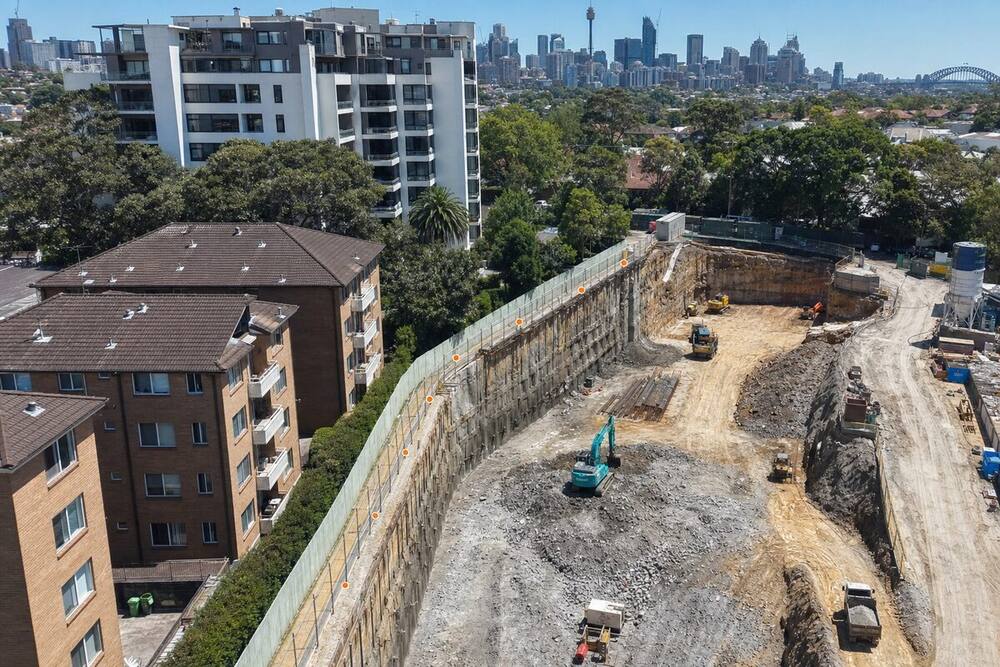
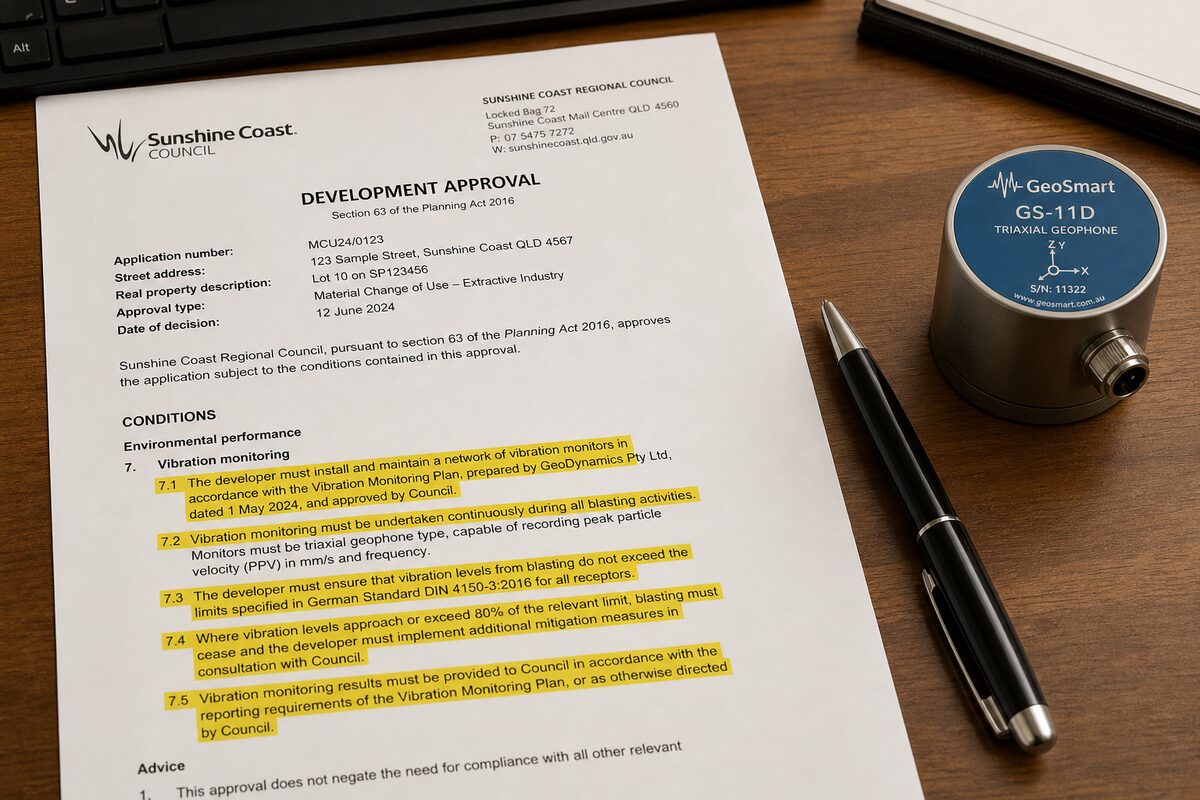
Construction vibration monitoring sits in a legal grey zone that catches many principal contractors off guard. A project can be well within safe operating limits by industry norms and still be in breach of a development approval condition, a SARA referral requirement, or a TMR MRTS specification that mandates monitoring regardless of predicted vibration levels. Understanding where these obligations originate, and which authority imposes them, is the first step in building a compliant monitoring programme before earthworks or piling commences.
The threshold question is not always "will this project generate harmful vibrations?" It is often "does this project trigger a statutory obligation to monitor, irrespective of risk level?" Those are different questions with different answers. A small demolition contract adjacent to a heritage-listed structure, a bored pier programme within Queensland Rail's proximity corridor, or a road widening project under TMR's jurisdiction can each carry mandatory monitoring conditions that attach to the approval, the contract, or the asset owner's operating requirements. Missing those triggers at the planning stage creates programme risk, potential stop-work exposure, and disputes over who bears the cost of retrofitting instrumentation mid-construction.
This article sets out the principal regulatory and contractual pathways that create legally binding vibration monitoring obligations in Queensland and, where relevant, across Australian jurisdictions, so that developers, principal contractors, and project managers can identify their obligations before mobilisation.
What "Legally Required" Actually Means in This Context
Mandatory vibration monitoring can arise from several distinct sources, and each carries different enforcement mechanisms. A condition attached to a development approval under the Planning Act 2016 (Qld) is enforceable by the relevant assessment authority. A SARA referral condition is enforceable by the State Assessment and Referral Agency. A TMR contract specification is enforceable through the construction contract. A Queensland Rail proximity agreement is a private instrument but carries the force of an asset owner's operating rules. An environmental authority condition issued under the Environmental Protection Act 1994 (Qld) is enforceable by the Department of Environment and Science.
Each pathway has its own trigger criteria, its own monitoring specifications, and its own reporting obligations. A project that crosses multiple jurisdictions, such as a road-rail interface project in a declared master planned area, can simultaneously attract obligations from several of these sources. The practical consequence is that monitoring system design must satisfy the most stringent applicable requirement, not simply the most convenient one.
SARA Referral Conditions
The State Assessment and Referral Agency assesses development applications that trigger state interests under the Planning Act 2016 (Qld) and the State Development Assessment Provisions (SDAP). Where a proposed development involves excavation, blasting, driven piling, dynamic compaction, or other high-energy ground disturbance activities in proximity to state transport infrastructure, heritage places, or state-controlled waterways, SARA will typically impose referral conditions as part of the development approval.
These conditions commonly require:
- Pre-construction baseline surveys: using triaxial geophones or MEMS accelerometers to establish ambient vibration levels at sensitive receivers before works commence
- Real-time continuous monitoring: during all vibration-generating activities, with data transmission to a web-accessible platform
- Alert and action thresholds: set below the DIN 4150-3 or AS 2187.2 guideline limits, often at 70-80% of the relevant structural damage criterion
- Incident reporting: within defined timeframes (typically 24-48 hours) when trigger levels are exceeded
- Post-construction condition surveys: of affected structures to document any changes attributable to construction activity
SARA conditions referencing vibration typically cite DIN 4150-3:2016 as the structural assessment standard, with cosmetic damage thresholds for residential structures commonly set at 5 mm/s PPV for continuous vibration and 20 mm/s PPV for transient events, depending on frequency content. Where heritage structures are involved, SARA conditions frequently impose more conservative limits, sometimes as low as 2-3 mm/s PPV for continuous works. These limits are applied at the structure, not at the site boundary, so sensor placement at the affected building is required rather than perimeter monitoring.
The critical point for developers is that SARA conditions are non-negotiable once issued. Requesting condition amendments post-approval is a formal process and does not suspend the original obligation.
TMR MRTS Requirements
Transport and Main Roads' Specifications framework, particularly the Mandatory Requirements for Technical Specifications (MRTS), imposes monitoring obligations through the construction contract rather than through the planning approval. MRTS70 (Earthworks) and MRTS05 (General Requirements) are the primary documents relevant to vibration.
Under TMR contracts, vibration monitoring is typically mandatory when work is conducted:
- Within 50 metres of existing pavement: subject to compaction or moisture sensitivity constraints
- Within 100 metres of bridges, culverts, or retaining structures: during dynamic compaction, vibratory roller operation, or driven pile installation
- Within proximity of rail infrastructure: subject to TMR's own infrastructure protection requirements
- Adjacent to residents or sensitive receivers: where the contract Environmental Management Plan requires verification of compliance with noise and vibration criteria
TMR specifications typically reference AS 2187.2-2006 for blasting vibration and DIN 4150-3 for mechanical construction vibration. The specifications often require the contractor to submit a Vibration Monitoring Plan for TMR approval before any monitoring-trigger activity commences. This plan must identify the monitoring instruments (triaxial geophones with a measurement range adequate for the anticipated PPV values), the data acquisition system, alert protocols, and the responsible party for data review.
Where TMR projects involve road-rail interface works, the TMR vibration requirements and Queensland Rail's own proximity requirements apply concurrently, and the more conservative specification governs.
MRTS Reporting Obligations
TMR contracts typically require:
- Daily vibration summaries: during active monitoring periods, submitted to the superintendent
- Exceedance reports: within 24 hours of any alert threshold breach
- End-of-construction monitoring reports: as a contract deliverable required before practical completion
Non-compliance with MRTS monitoring specifications is a contract nonconformance. On TMR projects, repeated non-conformances can trigger hold points that prevent the contractor from proceeding with subsequent works.
Brisbane City Council Development Approval Conditions
Brisbane City Council assesses development applications under the Brisbane City Plan 2014. Where a development application involves excavation or vibration-generating activities in proximity to heritage places, adjoining structures with shallow foundations, or high-density residential neighbourhoods, BCC planning officers routinely impose vibration monitoring conditions as part of the development approval.
BCC conditions are commonly attached to approvals for:
- Deep basement excavations: in the inner city, where sheet piling, rock breaking, and tieback installation affect adjacent structures
- Demolition of multi-storey structures: in high-density areas, particularly where hydraulic hammers or drop balls are used
- Driven or vibratory piling: within 50 metres of existing structures on sensitive soils
- Rock blasting: anywhere within the urban area, where AS 2187.2 compliance must be demonstrated by measurement
BCC conditions typically specify that monitoring must be performed by a suitably qualified person, which in practice means a RPEQ-qualified engineer supervising the monitoring programme. The conditions will specify the applicable standard (DIN 4150-3 for structural vibration assessment is common), the monitoring locations, and the frequency of reporting. BCC also commonly requires that monitoring records be made available to Council on request, which means data must be stored in a retrievable format for the duration of the development approval.
Where BCC-approved demolition contracts are assessed against Brisbane's Demolition Code provisions, vibration limits are often expressed as a percentage of the DIN 4150-3 Line 1 guideline values, reducing the permissible threshold for night-time works and for structures classified as particularly sensitive. Contractors who rely solely on industry rule-of-thumb limits without checking approval conditions risk operating outside their approval.
Queensland Rail Proximity Requirements
Queensland Rail's Network Rules and associated Infrastructure Management System requirements apply to all works within the Queensland Rail corridor and within proximity corridors defined by QR's asset management framework. For heavy rail corridors, the standard proximity zone for mandatory vibration monitoring is typically 50 metres from the centreline of the nearest track, though this varies by track speed classification and ground conditions.
Works requiring a Queensland Rail Possession or Interface Agreement that involve vibration-generating activity will trigger mandatory vibration monitoring as a standard condition of the agreement. These requirements typically specify:
- Triaxial geophone installation: at the rail corridor boundary and at nominated track monitoring points
- Continuous real-time monitoring: during all vibration-generating activity within the proximity corridor
- Alert thresholds: at vibration levels that may affect track geometry, ballast stability, or signalling infrastructure
- Immediate cessation protocols: if monitoring data exceeds the action threshold, pending QR engineering review
QR's internal specifications reference their own infrastructure limits, which are more conservative than DIN 4150-3 residential limits. The threshold for track-critical infrastructure is set to protect ballast stability and track geometry, not simply structural integrity in the DIN 4150-3 sense. Contractors unfamiliar with these specifications sometimes underestimate how sensitive the trigger levels are relative to standard construction vibration criteria.
Where underground infrastructure, including QR's cross-river rail tunnels and underground busway assets, is present, proximity monitoring may also require tunnel deformation monitoring using automated total stations or settlement monitoring arrays in addition to vibration measurement.
Environmental Authority Conditions Under the EP Act
For prescribed activities under the Environmental Protection Act 1994 (Qld), the Department of Environment and Science (formerly the EPA) issues environmental authorities that may contain vibration conditions. This pathway is most relevant to:
- Quarrying and extractive industry operations: where blasting occurs
- Major earthworks contracts: classified as environmentally relevant activities
- Demolition of structures containing hazardous materials: , where vibration could affect dust containment
Environmental authority conditions for vibration typically reference AS 2187.2-2006 for blasting and may additionally specify compliance with the Environmental Protection (Noise) Policy 2019 (Qld) for receiver amenity, which does not directly address structural vibration but is relevant where vibration complaints are anticipated. DES can require monitoring data to be submitted as part of annual returns for environmental authorities, and non-compliance with monitoring conditions can result in penalty infringement notices or prosecution.
How to Identify Whether Your Project Triggers Mandatory Monitoring
The identification process should occur at the planning stage, before the principal contractor is appointed. The following decision pathway covers the main triggers:
- Check the development approval conditions: issued by BCC, the local government, or the assessment authority. Search for conditions referencing vibration, noise, or construction management that require monitoring by an independent party or RPEQ.
- Check whether SARA has been a referral agency: on the development application. If SARA is listed as a concurrence agency or advice agency, request the full set of SARA conditions. These are sometimes incorporated by reference into the development approval and not reproduced in the main condition schedule.
- Check whether TMR is the client or the infrastructure owner.: If the project is a TMR-funded road project, obtain the full MRTS specification suite. If works are adjacent to a state-controlled road, check whether a Road Corridor Permit has been issued with conditions.
- Check the proximity of the works to Queensland Rail infrastructure.: If works are within 50 metres of any QR corridor, a Proximity Agreement will likely be required. Contact QR's Infrastructure Management team for the applicable interface requirements.
- Check whether an environmental authority exists: for the project or for activities that will occur as part of the project. Request the full schedule of conditions from DES if applicable.
- Check heritage listings.: If the project is within 100 metres of a Queensland Heritage Register place or a local heritage place, SARA or the local government may have imposed conservative vibration limits that require monitoring verification.
- Review the geotechnical report.: Where soils are soft, liquefiable, or have a history of settlement, the geotechnical engineer may have recommended vibration monitoring as a risk management measure that subsequently becomes a contractual obligation.
Where any of these checks returns a positive result, a qualified monitoring engineer should be engaged to design a monitoring programme that satisfies all applicable requirements simultaneously. Attempting to address each obligation separately with different monitoring approaches often results in gaps in coverage and data formats that cannot satisfy multiple reporting obligations.
What a Compliant Monitoring Programme Looks Like
A monitoring programme that satisfies SARA, TMR, BCC, and QR obligations concurrently will typically include:
- Triaxial geophones or MEMS accelerometers: at each nominated sensitive receiver and infrastructure asset, selected for the frequency range relevant to the works (typically 1-315 Hz for construction vibration per DIN 4150-3)
- Real-time data transmission: to a cloud-hosted monitoring platform with configurable alert thresholds and automated exceedance notification to the contractor, superintendent, and regulator
- Independent data review: by an RPEQ-qualified engineer with sign-off on daily and weekly monitoring reports
- Pre-construction and post-construction condition surveys: of all monitored structures, documented with photographic records and licensed surveyor or structural engineer certification
- A Vibration Monitoring Plan: submitted to each relevant authority before works commence, describing the instrumentation, calibration schedule, data management system, alert protocols, and reporting format
Instrument calibration records should be maintained and available for audit. Geophones should be calibrated against a traceable reference standard, and calibration certificates should not exceed the manufacturer's recommended recalibration interval, typically 12 months.
Conclusion
Mandatory vibration monitoring obligations in Queensland arise from at least five distinct regulatory and contractual pathways: SARA development approval conditions, TMR MRTS specifications, BCC development approval conditions, Queensland Rail proximity agreements, and DES environmental authority conditions. Each pathway has independent trigger criteria and enforcement mechanisms. A project that appears straightforward at the planning stage may cross multiple jurisdictions and attract obligations that must be satisfied simultaneously.
The identification of monitoring obligations before mobilisation is not a compliance formality. It is the mechanism by which construction programmes avoid hold points, stop-work notices, and post-completion disputes over structural damage to third-party assets. Principal contractors, developers, and project managers who integrate this check into their pre-construction planning process will find that monitoring system design is far simpler and less costly than retrofitting instrumentation after a regulator or asset owner raises a concern during construction.
For project-specific advice on identifying your vibration monitoring obligations and designing a compliant monitoring programme, contact the Oculus Technology team at [oculustech.au/services/vibration-monitoring](https://oculustech.au/services/vibration-monitoring).
Need monitoring for your project?
Share your site context, approval conditions, and project timeline. We'll respond with a practical monitoring scope within 24 hours.
Request a Scope