Construction Noise Monitoring: Your Obligations in Queensland
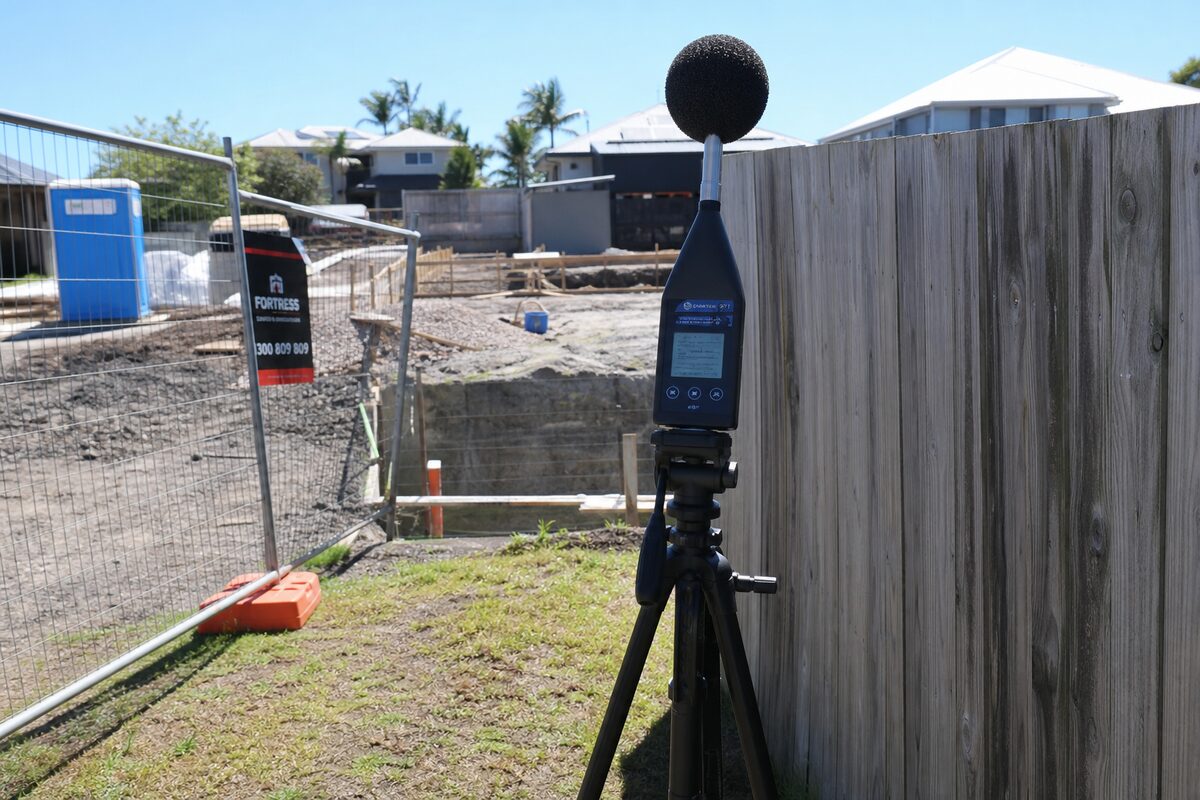
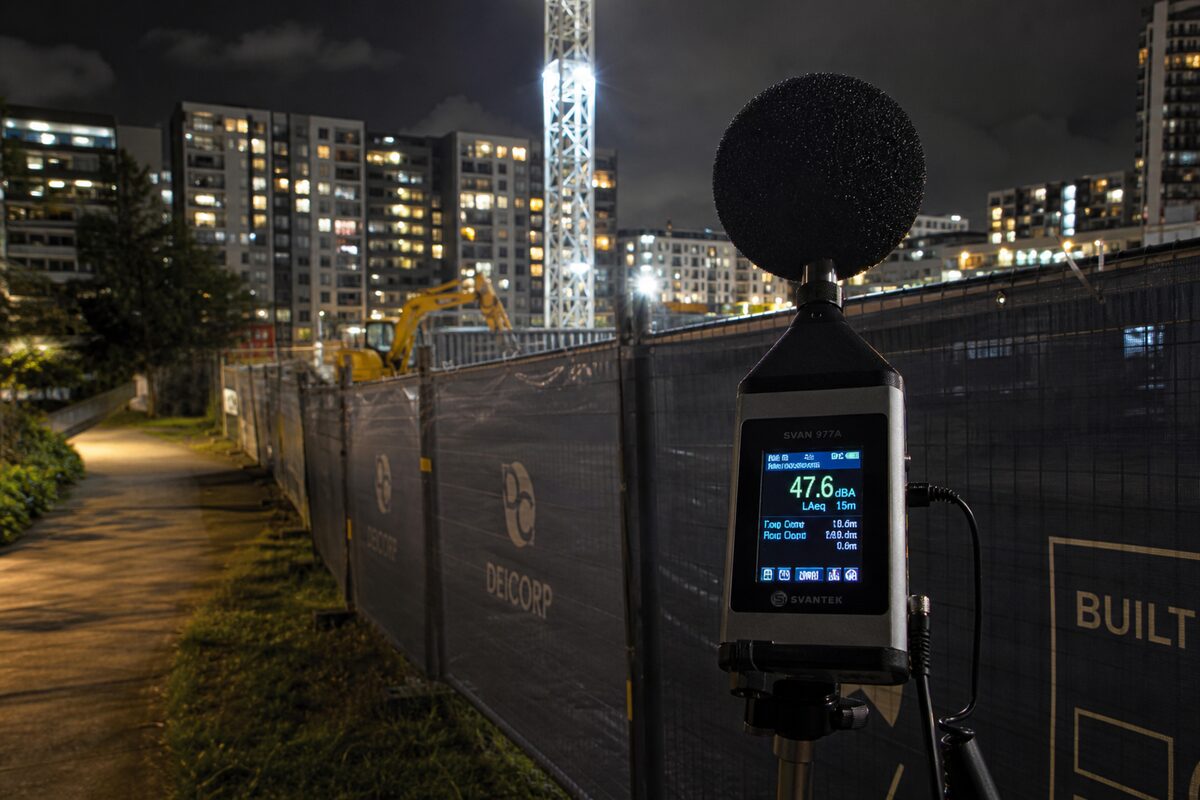
Construction sites in Queensland generate noise across a wide frequency range, from low-frequency plant rumble through to high-pitched cutting and drilling. Managing that noise is not optional. The Environmental Protection (Noise) Policy 2019 (NPP 2019) establishes statutory acoustic amenity standards across the state, and the Environmental Protection Act 1994 gives the Department of Environment and Science (DES) and local governments the authority to issue compliance notices, on-the-spot fines, and environmental protection orders against contractors who breach them. Understanding what those obligations actually require in practice, and how to measure against them correctly, is where most principal contractors fall short.
The gap between what the NPP 2019 requires and what gets implemented on site is often a measurement methodology problem rather than a genuine exceedance. Noise measurements taken at the wrong location, with the wrong instrument class, or without proper background noise characterisation routinely produce results that appear non-compliant when the underlying noise impact is within acceptable limits. Equally, poorly planned monitoring programmes miss genuine exceedances during high-energy activities like rock breaking, piling, and concrete cutting. Both outcomes carry project risk.
This article covers the core obligations under Queensland's noise regulatory framework, how AS 1055 measurement methods apply in practice, what exceedance criteria actually mean, and what principal contractors are required to do when limits are breached.
The Regulatory Framework in Queensland
The NPP 2019 is a statutory instrument made under the Environmental Protection Act 1994. It establishes acoustic quality objectives (AQOs) for different areas based on their land use classification. The policy defines day, evening, and night time periods and sets corresponding noise limits that apply at noise-sensitive places, which the NPP defines specifically to include residences, schools, hospitals, and places of worship.
Queensland local governments, including Brisbane City Council (BCC), Gold Coast City Council, and others, can also impose construction noise conditions through development approvals (DAs) issued under the Planning Act 2016. These DA conditions commonly adopt the NPP 2019 limits or add stricter site-specific requirements. The Queensland Department of Transport and Main Roads (TMR) applies its own acoustic requirements under the MRTS framework for road corridor works, which may invoke both the NPP 2019 and the Commonwealth EPBC Act where sensitive ecological receptors are present. Principal contractors working across different approval frameworks need to confirm which instrument takes precedence on any given project before establishing their monitoring programme.
DES retains enforcement authority over activities that hold an environmental authority (EA) under the EP Act. For construction activities that do not hold an EA, local government is typically the enforcement body for noise complaints, with the power to issue notices and direct noise management plan revisions.
Acoustic Quality Objectives and Exceedance Criteria
The NPP 2019 sets AQOs for three primary periods across four area categories. The most commonly applicable limits for construction activity near residential receivers are:
- Day period (7:00 am to 6:00 pm Monday to Saturday):: LA10 not more than 5 dB(A) above the background level, with an absolute limit typically referenced at 65 dB(A) LA10 for residential areas
- Evening period (6:00 pm to 10:00 pm):: Reduced limits apply, with LA10 and LAeq thresholds tightening by approximately 5 dB(A) relative to day limits
- Night period (10:00 pm to 7:00 am):: Most restrictive period; construction noise is generally prohibited unless DA conditions or an EA explicitly permit it
The policy uses two primary descriptors. LA10 is the sound pressure level exceeded for 10% of the measurement period, measured in dB(A). It characterises intrusive or fluctuating noise sources well and is the standard descriptor for most construction noise assessment under the NPP 2019. LAeq is the equivalent continuous sound level, the time-averaged energy of the noise signal over the measurement period, and is often specified in development approval conditions, environmental authorities, and neighbour agreements where a single time-averaged metric is required.
When assessing whether a measurement constitutes an exceedance, the result must be compared against the applicable criterion for that area, time period, and land use category. A single peak reading does not establish an exceedance; the measurement period and method must conform to AS 1055 before the result has regulatory standing.
AS 1055 Measurement Methods
AS 1055 is the Australian Standard for acoustics and the description and measurement of environmental noise. It sets out how noise measurements must be taken to produce results that are technically defensible. The standard is referenced explicitly in Queensland's NPP 2019 as the required measurement methodology.
Instrument Requirements
Measurements must be made with a Type 1 or Type 2 sound level meter conforming to IEC 61672-1. Type 1 instruments offer higher accuracy and are preferred for compliance measurements where results are likely to be disputed. All instruments must hold a current calibration certificate traceable to NATA-accredited standards, and field calibration checks must be performed immediately before and after each monitoring session using an acoustic calibrator conforming to IEC 60942.
Measurement Position
The measurement microphone must be positioned at the noise-affected place or at a representative location as close as practicable to the boundary of that place. AS 1055 specifies a microphone height of 1.2 to 1.5 metres above ground level for free-field measurements. The microphone must be at least 3.5 metres from any reflective surface unless a 3 dB correction for free-field conditions is applied. Measurements taken at positions that fail these criteria cannot be relied upon to demonstrate either compliance or exceedance.
Windshields and Meteorological Conditions
A windshield must be fitted when measuring outdoors. Wind speeds above approximately 5 m/s introduce aerodynamic noise at the microphone capsule that contaminates readings, and measurements taken in these conditions should be flagged or excluded. Temperature and humidity should also be logged; significant humidity can affect outdoor sound propagation over longer measurement paths.
Measurement Duration
The measurement period must be sufficient to characterise the noise source adequately. For fluctuating construction noise, AS 1055 generally requires measurement periods of at least 15 minutes, with multiple periods recorded across representative phases of the construction activity. Spot measurements of shorter duration are not sufficient for compliance assessment unless the noise source is demonstrably steady-state.
Background Noise Assessment
Establishing the background noise level (BNL) is the step that most monitoring programmes handle incorrectly. The NPP 2019 exceedance criteria are expressed as a margin above the background, which means the background level at the receiver location must be measured independently of the construction activity.
Background noise should be measured during periods when the construction source is inactive but all other ambient sources are representative: road traffic, industrial activity, air conditioning, and local fauna. The measurement descriptor for background under the NPP 2019 is LA90, the level exceeded for 90% of the measurement period, which represents the underlying noise floor rather than transient or intrusive events. Background measurements should be taken across multiple sessions covering different times of day and different days of the week, including weekends, to produce a statistically representative LA90 value.
A construction site that begins activity in a quiet suburban environment where the background LA90 is 35 dB(A) faces a much tighter compliance margin than one operating in a commercial corridor with a background of 55 dB(A). This asymmetry is why pre-construction background monitoring is not a bureaucratic exercise: it directly determines how much noise budget the contractor has to work with.
Background noise surveys should be completed before any site establishment activity begins. Once piling rigs, generators, and water pumps are on site, the ambient environment is already contaminated and the baseline is lost.
Continuous vs. Attended Monitoring
Queensland construction projects typically require some combination of attended (manual) and unattended continuous monitoring depending on the scale of works, the sensitivity of nearby receptors, and the conditions imposed by the DA or EA.
Attended Monitoring
Attended monitoring involves a trained acoustic technician operating a Type 1 or Type 2 sound level meter at specified receptor locations during defined activities. This approach is appropriate for:
- Commissioning tests:: Verifying that a new piece of plant or a particular work method stays within limits before it becomes standard practice
- Complaint investigation:: Characterising a specific noise event in response to a neighbour or regulator inquiry
- Pre-start assessments:: Confirming background conditions before commencing a high-noise activity like hydraulic rock breaking or impact piling
Unattended Continuous Monitoring
Unattended monitoring stations use weatherproofed sound level meters or noise loggers mounted at fixed positions to record 1-minute or shorter LAeq and LA10 data continuously. Modern noise loggers conforming to IEC 61672-1 can store time-stamped statistical descriptors and flag exceedances automatically. Cloud-connected systems allow real-time data access, enabling construction managers to receive SMS or email alerts when thresholds are approached or breached.
Continuous monitoring is generally required on large urban infrastructure projects, projects with extended hours approvals, and sites adjacent to hospitals, schools, or residential towers. The data record from continuous monitoring serves as both a compliance log and a defence against unsubstantiated complaints, because time-stamped measurements can be cross-referenced against site activity records to determine causation.
What Principal Contractors Must Do When Limits Are Breached
An exceedance measured in accordance with AS 1055 against the applicable NPP 2019 or DA condition criterion triggers specific obligations. These are not discretionary.
Immediate Response
When monitoring data identifies an exceedance during working hours, the first obligation is to identify the source. In most cases, this means pausing the activity and confirming whether the measurement reflects genuine emission from the site or an external contaminating source such as passing traffic. If the source is confirmed as site activity, operations contributing to the exceedance must be modified or suspended until noise levels are within limits.
Notification Requirements
Development approval conditions frequently require the principal contractor to notify the relevant assessment manager (typically BCC, a local government, or TMR for state-controlled road corridors) within a defined period after an identified exceedance, often 24 to 48 hours. Environmental authority conditions may require notification to DES. Failure to notify when required is a separate offence from the exceedance itself and can carry additional penalties under the EP Act.
Noise Management Plan Revision
Where an exceedance pattern indicates that standard work methods cannot achieve compliance, the Noise Management Plan (NMP) must be revised. Revision triggers typically include three or more exceedances in a defined period, a regulator direction, or a complaint verified by measurement. NMP revisions should identify:
- Source control measures:: Substituting electric plant for diesel, fitting acoustic enclosures to compressors and generators, using rock saws rather than hydraulic breakers where geotechnical conditions permit
- Operational controls:: Restricting high-noise activities to mid-day when background noise is highest and receptors are least sensitive, rotating noisy plant to maximise distance from receptors
- Administrative controls:: Pre-notification of neighbours before particularly noisy activities, revised works scheduling, temporary acoustic barriers or hoarding upgrades
Reporting and Record-Keeping
Principal contractors must retain noise monitoring records for the duration of the project and for at least five years afterwards under Queensland's EP Act record-keeping obligations. Records should include raw measurement files, calibration certificates, meteorological data, site activity logs cross-referenced to monitoring periods, and any correspondence with regulators or affected parties. These records are discoverable in enforcement proceedings and civil claims.
Noise Management Plans in Practice
A Noise Management Plan is the operational document that describes how the principal contractor will achieve compliance across the construction programme. DA conditions for medium and large projects typically require an NMP to be prepared by a suitably qualified person (an acoustic consultant) and submitted for approval before earthworks commence.
An NMP should address the full construction programme in phases, identify which activities generate the highest noise exposure, nominate the monitoring locations that represent the most sensitive receptors, and set internal action levels below the regulatory limits to provide a warning margin. Setting action levels at, say, 3 dB(A) below the applicable criterion means the site team has an opportunity to intervene before a regulatory breach occurs.
The NMP should also identify what monitoring technology will be deployed, at what locations, and at what data capture interval. For projects using unattended continuous monitors, the NMP should specify the alert thresholds, who receives alerts, and what the escalation procedure is from first alert through to regulator notification if required.
Conclusion
Construction noise obligations in Queensland are defined by a clear regulatory hierarchy: the EP Act provides the enforcement framework, the NPP 2019 sets the acoustic quality objectives, development approval and environmental authority conditions specify site-specific requirements, and AS 1055 governs the measurement methods that give those limits technical meaning. Getting any one of those elements wrong produces monitoring data that is either misleading or legally undefendable.
Principal contractors who invest in pre-construction background noise surveys, deploy correctly specified instrumentation at representative receptor locations, and maintain auditable records across the project programme are in a substantially better compliance position than those who treat noise monitoring as a box-ticking exercise. When exceedances do occur, the response pathway is not complicated, but it must be followed: identify the source, apply source controls, notify where required, revise the NMP if the pattern persists, and maintain the records.
Oculus Technology deploys unattended noise monitoring stations and provides attended measurement programmes on construction projects across Queensland, with data managed through cloud-connected platforms and reporting prepared against NPP 2019 and project-specific DA conditions. Further information on our acoustic monitoring services is available at [oculustech.au/services/noise-monitoring](https://oculustech.au/services/noise-monitoring).
Need monitoring for your project?
Share your site context, approval conditions, and project timeline. We'll respond with a practical monitoring scope within 24 hours.
Request a Scope