AS 2187.2 Vibration Limits Explained: What Construction Teams Need to Know
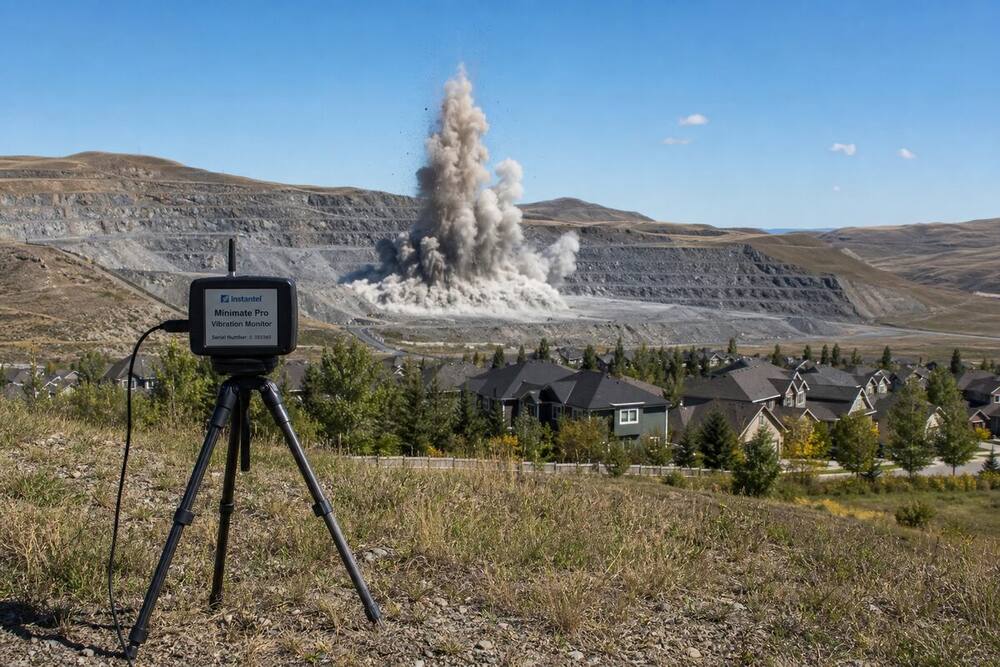
AS 2187.2 is the primary Australian standard governing the use of explosives, and its vibration annex sets out the ground vibration and overpressure limits that govern blasting operations across Queensland and the rest of the country. For project teams working near sensitive receivers, understanding how those limits are structured, and why they vary with frequency, is not optional. Getting it wrong means exceeding development approval conditions, triggering complaints to the Department of Environment and Science (DES), or worse, causing cosmetic or structural damage to adjacent buildings that the contractor is then liable to repair.
What makes AS 2187.2 more demanding to apply than people expect is the frequency-dependent nature of its damage criteria. It is not a single number. The standard sets different peak particle velocity (PPV) limits depending on the dominant frequency of the ground wave arriving at the structure, and those frequencies shift depending on geology, distance, charge weight, and the type of blasting or mechanical impact being used. A monitoring programme that captures PPV but ignores frequency is only doing half the job. This article explains the structure of the standard, what the limits mean in practice, and how construction teams on piling and demolition sites set up monitoring to stay compliant.
---
What AS 2187.2 Actually Covers
AS 2187.2 is Part 2 of the AS 2187 series, which deals specifically with the use of explosives. The vibration and airblast provisions sit in Section 8 of the standard and apply to any blasting operation where ground vibration could affect adjacent structures or people. In practice, Queensland regulators and approval bodies including SARA (State Assessment and Referral Agency) and BCC routinely reference AS 2187.2 conditions directly into development approvals and environmental authorities issued under the Environmental Protection Act 1994.
The standard addresses two distinct hazard pathways. The first is ground-borne vibration, measured as PPV in millimetres per second, which governs structural damage risk to buildings and other assets. The second is airblast overpressure, measured in decibels (dB(L)), which governs the pressure wave transmitted through the air from a blast event. Both require independent monitoring and both have separate limits. This article focuses primarily on the ground vibration component because it is the one most frequently misunderstood and most often the subject of disputes between contractors and asset owners.
It is also worth noting where AS 2187.2 ends and other standards begin. For continuous or intermittent mechanical vibration from piling, rock breaking, or demolition, the standard does not strictly apply, though its limits are often used as a reference. In those contexts, DIN 4150-3 (the German standard for structural vibration) and BS 7385-2 (the British equivalent) are commonly cited in parallel, and some Queensland environmental authorities explicitly reference all three. Understanding the relationship between these documents is part of operating a defensible monitoring programme.
---
The PPV Limit Structure: Why Frequency Matters
The central insight in AS 2187.2 is that a building's response to ground vibration depends not just on how large the vibration is, but on what frequency it arrives at. Low-frequency waves couple more effectively with the natural resonant frequencies of typical residential structures, which tend to sit in the 4-10 Hz range. A PPV of 10 mm/s arriving at 5 Hz can cause more cosmetic damage than the same PPV arriving at 40 Hz, because the building has more time per cycle to amplify the motion.
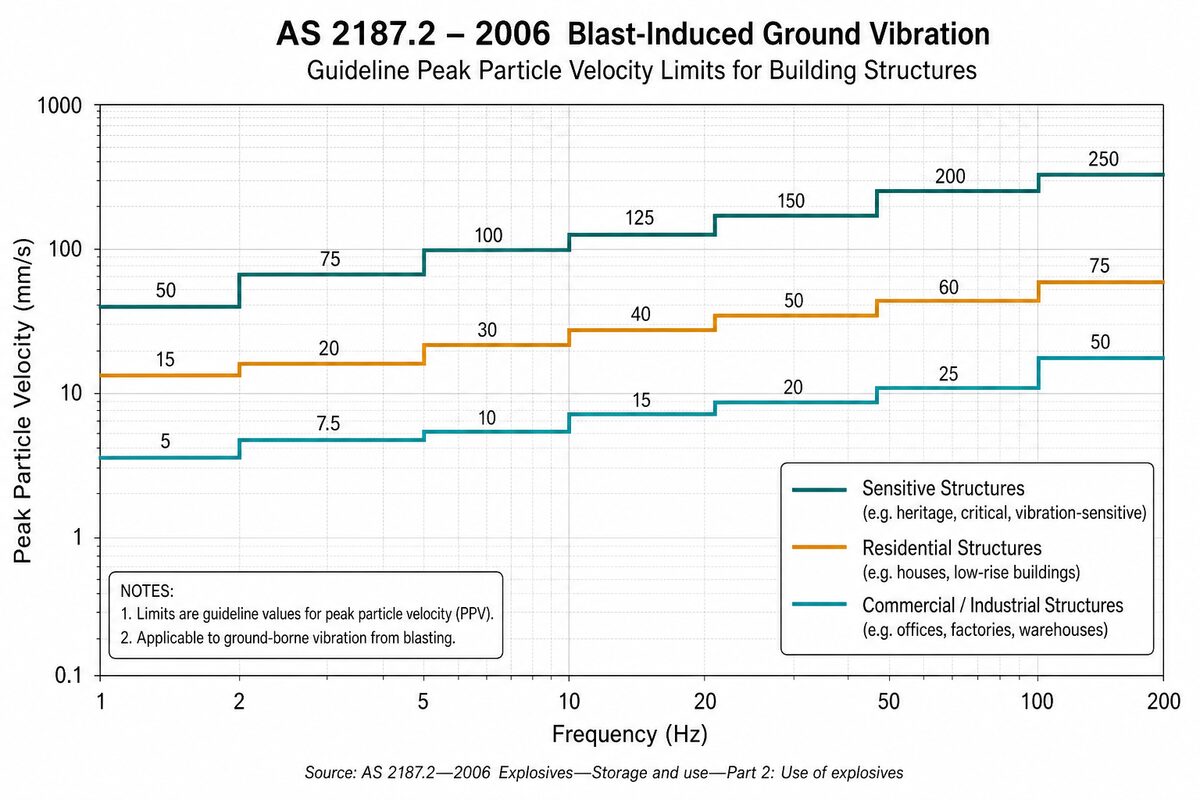
The standard addresses this by setting a sliding PPV limit that increases with frequency. For structural damage assessment of residential and lightweight commercial structures, the limits follow this general pattern:
- Below 4 Hz:: PPV limits are at their most conservative, reflecting the risk of resonant amplification in low-rise structures. Limits in this range are typically in the order of 5 mm/s or lower depending on the building classification.
- 4 to 15 Hz:: This is the critical mid-range where most blast-induced ground waves from quarry and construction blasting sit. Limits for residential structures are typically 10 mm/s PPV in this band.
- 15 to 40 Hz:: Limits increase progressively. At the upper end of this range, typical limits for residential structures reach around 25 mm/s PPV.
- Above 40 Hz:: At high frequencies, the velocity limit may extend further, but in practice, blasting rarely generates dominant energy this high at the distances relevant to construction sites near receivers.
These thresholds are not arbitrary. They are derived from empirical damage studies and align broadly with the frameworks used in DIN 4150-3 and BS 7385-2, which use similar frequency-dependent curves. The difference is that the German and British standards use graphical compliance curves rather than discrete band limits, which makes interpolation easier but can make regulatory reporting more complex.
---
Building Classifications and Sensitivity Levels
AS 2187.2 does not apply a single limit to all structures. It classifies receivers into categories based on their construction type and sensitivity, and applies different limits to each. Project teams need to identify the classification of every sensitive receiver within the zone of influence before setting blast design parameters or trigger levels.
The broad classifications used in the standard and adopted by Queensland regulators include:
- Residential buildings and similar lightweight structures:: This includes houses, townhouses, and low-rise apartments built with conventional timber or masonry construction. These attract the most conservative limits and are the most common receiver type on urban construction sites.
- Commercial and industrial structures:: Heavier construction with higher inherent stiffness. These can tolerate higher PPV levels before damage risk increases, and the standard reflects this with higher threshold values.
- Heritage-listed and sensitive structures:: This category requires particular attention. Structures on the Queensland Heritage Register or subject to heritage conditions in a development approval may have limits significantly below the standard residential thresholds. Owners and project managers need to check approval conditions, not just the standard itself.
- Vibration-sensitive equipment and processes:: Hospitals with imaging equipment, data centres, and research facilities may require assessment against AS/NZS 1170 or specific equipment manufacturer tolerances rather than AS 2187.2 structural limits.
In practice on Queensland construction sites, SARA and BCC conditions often specify the applicable limits numerically in the environmental authority or development approval, referencing AS 2187.2 but sometimes modifying the thresholds downward for particular receivers. Always read the approval conditions against the standard, not instead of it.
---
Scaled Distance and Blast Design
Meeting the PPV limits in AS 2187.2 starts with blast design, not monitoring. Monitoring confirms compliance; blast design achieves it. The key design tool is the scaled distance formula, which relates charge weight per delay to distance and allows blast engineers to predict the expected PPV at a receiver before the shot is fired.
The scaled distance relationship used in Australian practice is:
PPV = K × (D / W^0.5)^(-n)
Where D is the distance from the blast to the receiver in metres, W is the maximum instantaneous charge (MIC) in kilograms per delay, and K and n are site-specific attenuation constants derived from trial blasts. The exponent and constant values vary with local geology, and using generic values without site-specific calibration is a source of significant non-compliance risk.
The practical implications for project teams are direct:
- Reduce the MIC:: Splitting a charge across more delay intervals reduces the maximum energy per delay, which reduces PPV at the receiver even for the same total explosive weight.
- Increase distance or buffer zones:: Where the site layout allows, increasing standoff distance from sensitive receivers gives the wave more distance to attenuate.
- Adjust delay timing:: Modern electronic detonators allow sub-millisecond precision in delay intervals, reducing constructive interference between blast holes and lowering peak vibration.
- Trial shots:: On sites near sensitive receivers, conducting monitored trial shots before production blasting lets the blast engineer calibrate local K and n values and confirm the design is achieving target PPV levels.
Blast design documentation showing predicted PPV against the applicable AS 2187.2 limit for each sensitive receiver should be part of the pre-blast notification package and retained for the project record.
---
Monitoring Equipment and Deployment
Confirming compliance with AS 2187.2 requires instrumentation capable of capturing both PPV and the frequency content of the vibration signal. A basic peak-reading device that records only the maximum PPV is insufficient for a frequency-dependent standard. The instrument must record waveforms and allow frequency analysis, either on-device or in post-processing.
The instruments used in Australian blast monitoring practice include:
- Triaxial geophones:: The standard sensor for blast vibration. Geophones measure ground velocity directly in three orthogonal axes (longitudinal, transverse, and vertical). True PPV is the vector sum or, more commonly in Australian practice, the highest single-channel peak. Instruments must be calibrated to NATA-traceable standards and have a flat frequency response across the range of interest.
- MEMS accelerometers:: Used where geophone sensitivity is insufficient or for continuous monitoring between blast events. Accelerometers measure acceleration and require integration to derive velocity, which introduces low-frequency noise if not managed carefully.
- Seismographs:: Integrated instruments that combine geophone sensors with on-board data logging, frequency analysis, and trigger-based recording. Units from manufacturers such as Instantel and Syscom are widely used in Queensland blast monitoring. These typically record at 1024 samples per second or higher and provide FFT or spectrum analysis alongside PPV readings.
Deployment requires the sensor to be in firm contact with the ground or structure being monitored. Loose coupling or placement on soft fill introduces errors that can either underestimate or overestimate actual structural response. On urban demolition and piling sites, sensors are often mounted directly to the foundation slab of the nearest sensitive building, which gives the most representative measure of the vibration input to that structure.
Data from blast events should be reviewed within hours, not days. If a threshold is approached or exceeded, the blast engineer needs to modify the design before the next shot. An automated alert system that sends SMS or email notifications when PPV approaches the trigger level is standard practice on Oculus Technology deployments. [Learn more about our vibration monitoring services](/services/vibration-monitoring).
---
Applying AS 2187.2 to Piling and Demolition
The standard's title references explosives, but its PPV limits are routinely applied to mechanical construction activities including impact piling, hydraulic rock breaking, and demolition by excavator. This application is technically an extension of the standard's intent rather than a strict regulatory requirement, but it is well-established in Queensland practice and is often explicitly required by development approval conditions.
For impact piling, the dominant frequencies are typically lower than blast-induced vibration, often sitting in the 3-10 Hz range depending on pile type, hammer energy, and soil conditions. This is the worst-case frequency band for residential structures under AS 2187.2's frequency-dependent criteria. Project teams sometimes find that piling generates vibration at the same absolute PPV level as a blasting event but causes more concern because of the lower frequency content and the repetitive nature of the loading.
Practical risk reduction for mechanical activities includes:
- Pre-boring:: Reducing the driven length by pre-boring through competent material before driving reduces the energy per blow required to achieve penetration.
- Reduced hammer energy in critical zones:: Modern hydraulic hammers allow energy adjustment. Operating at reduced energy near sensitive receivers and increasing energy as piles move away is a standard risk mitigation measure.
- Continuous monitoring with automated alerts:: Unlike blasts, which occur at discrete predictable times, piling and demolition are continuous activities. Monitoring must run continuously, and the alert threshold should be set below the compliance limit to give operators time to respond before a limit is exceeded.
- Vibration-free alternatives:: Where AS 2187.2 limits cannot be met with conventional driven piling, bored pile systems or pressed-in piles may be required. This is a cost implication that should be identified in early project planning, not after piling has started.
For demolition, the key risk period is typically the removal of large structural elements where debris impact can generate high-amplitude, low-frequency pulses. Monitoring during these phases should be continuous, with data reviewed in real time.
---
Documentation, Reporting, and Regulatory Compliance
A monitoring programme is only as useful as its documentation. For AS 2187.2 compliance, the minimum documentation set for each blast or significant mechanical event should include:
- Pre-event blast design records: showing predicted PPV, MIC, delay configuration, and scaled distance calculations for each receiver.
- Instrument calibration certificates: current to NATA-traceable standards, typically annual for seismographs.
- Event records: showing raw waveform data, PPV in all three axes, dominant frequency, and compliance status against the applicable limit for each monitoring location.
- Exceedance reports: where any limit is approached within 50% or exceeded. These should be submitted to the relevant regulator (DES, SARA, or BCC depending on the project's approval pathway) within the timeframe specified in the environmental authority, typically 24-48 hours.
- Receiver condition surveys: pre-construction and post-construction, documenting the condition of adjacent structures before work begins. A photographic and crack gauge baseline survey protects the contractor from claims of pre-existing damage.
Queensland's Environmental Protection Act 1994 and associated Environmental Protection (Noise) Policy 2019 frame the broader compliance environment within which AS 2187.2 sits. Regulators can and do inspect monitoring records, and the absence of adequate documentation is treated as a compliance failure in its own right, independent of whether any actual exceedance occurred.
---
Conclusion
AS 2187.2 is a frequency-dependent standard, and treating it as a simple PPV threshold misses the technical foundation that makes it effective as a damage prediction tool. The limits increase with frequency because building response decreases with frequency, and a monitoring programme that captures waveforms, analyses frequency content, and records all three axes gives the project team the data needed to confirm compliance, defend against claims, and adjust blast or piling design in real time.
For construction teams operating near sensitive receivers in Queensland, the practical requirements are clear: calibrated triaxial instrumentation, site-specific blast design using scaled distance relationships, continuous or triggered monitoring throughout the works, and complete event documentation retained for the life of the project. The frequency-dependent criteria in the standard are not a complication. They are the mechanism that prevents unnecessary conservatism at high frequencies while maintaining appropriate protection in the low-frequency range where residential structures are most vulnerable.
Oculus Technology designs and deploys vibration monitoring programmes for blast operations, piling, and demolition across South East Queensland and regional sites, with instrumentation calibrated to NATA-traceable standards and reporting structured to meet development approval and environmental authority conditions. [Contact our team](/services/vibration-monitoring) to discuss monitoring requirements for your project.
Need monitoring for your project?
Share your site context, approval conditions, and project timeline. We'll respond with a practical monitoring scope within 24 hours.
Request a Scope